12 Great iPad/iPhone MIDI Controller Apps (iOS)
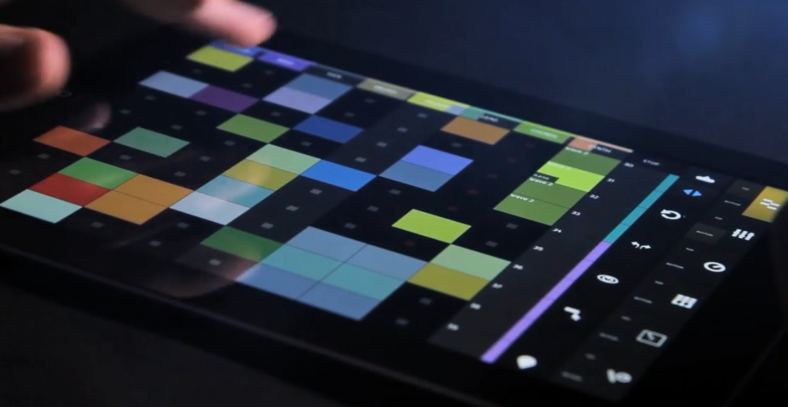
MIDI hardware devices can be quite an investment. MIDI controller apps let you turn an iPad or iPhone into a keyboard, a bank of faders, or a control surface with a layout that suits your setup.
In case you are looking for something different, here are two related articles:
There are MIDI apps for several different jobs: playing chords, sending expressive notes, automating synth parameters, and controlling a DAW. ChordPolyPad suits chord-based playing, while the free GeoShred Control is useful for expressive MIDI/MPE performance.
A MIDI controller sends instructions to another instrument or app; it does not necessarily make sound. Some choices below include sounds for practicing, while others need a MIDI-capable synth, hardware instrument, or DAW. A computer and wireless driver are not required for every setup: virtual MIDI can connect apps on one device, and compatible interfaces let you control hardware directly.
Here are 12 MIDI controller apps for iPad and iPhone. Arpeggionome Pro and Patch Base are iPad choices; the other listed apps support both. Check the stated system requirements before downloading, particularly on an older device.
Contents
1. ChordPolyPad
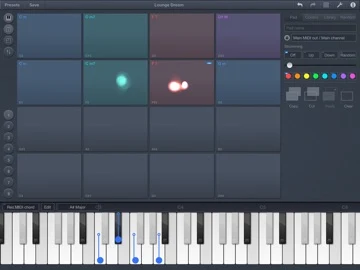
ChordPolyPad lets you build sets of playable chords from a library, your own notes, or its random chord generator. It is a good choice when you want to arrange a progression across pads and play it without repeatedly entering individual notes.
Each preset has 128 pads, arranged as eight groups of 16 or two groups of 64. Pads can have their own MIDI channel and output, and horizontal and vertical finger movements can send control messages. The internal sound bank lets you try ideas before routing MIDI to another instrument.
This is a paid standalone app for iPhone and iPad, with an included AUv3 MIDI effect for compatible hosts. The current version requires iOS/iPadOS 15 or later. Optional preset packs are separate purchases; you do not need a DAW to use its own sounds.
- Chord library, custom scales, per-note velocity, and strumming controls
- MIDI over virtual ports, compatible interfaces, Wi-Fi, or Bluetooth
- AUv3 use requires a host that supports MIDI effects, such as AUM or Cubasis
View Price – App Store
2. ChordUp
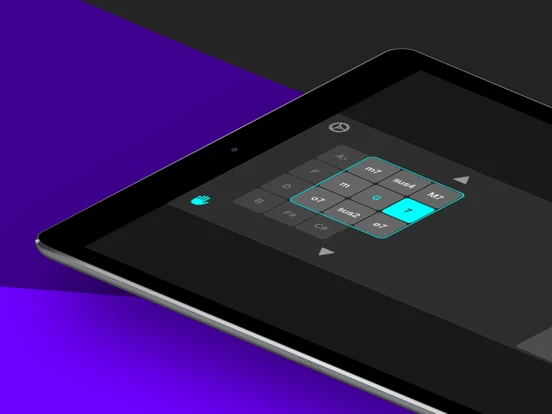
ChordUp is a chord-playing instrument and MIDI controller that gives you quick access to common chords. Tap a root note and slide toward a chord type, then use its playing surfaces for full chords, individual notes, or strumming.
It includes 108 chords and 10 built-in instruments, including piano, guitar, organ, and strings. The pad and string layouts give you different ways to play the same harmony, while smart sustain keeps shared notes ringing as you change chords.
ChordUp is a paid app for iPhone and iPad running iOS/iPadOS 15.6 or later. It works on its own, or sends MIDI to other apps and hardware through Core MIDI and Audiobus 3. Bluetooth MIDI can connect another iOS device; Mac connections also support Wi-Fi or USB.
- Chord locking, octave transposition, and adjustable button sizes on iPad
- Built-in sounds let you practice without another synth
- Its chord-focused layout suits accompaniment better than a general-purpose DAW control surface
View Price – App Store
3. GeoShred Control
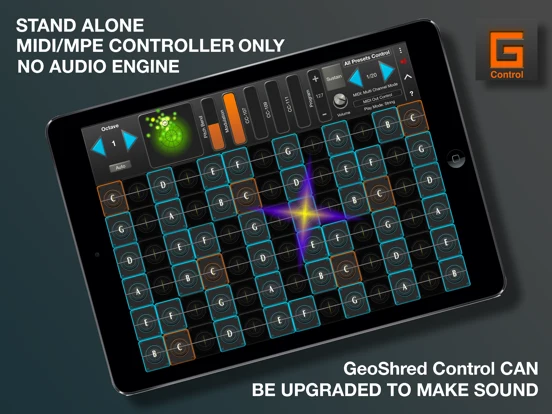
GeoShred Control is a free MIDI/MPE controller with an expressive playing surface. It does not have a built-in sound engine: connect a MIDI-capable instrument to hear your playing. If you already own GeoShred Pro, its MIDI functions are already included.
The fretboard-style layout supports slides, vibrato, and scale-based playing. It can work especially well with MPE instruments, which respond to expression from individual notes. The arpeggiator, alternative tunings, world scales, and pitch rounding give it more range than a conventional on-screen piano keyboard.
GeoShred Control 7 runs as a standalone iPhone/iPad app or as an AUv3 MIDI plug-in in a compatible host. The current download requires iOS/iPadOS 15 or later. A paid in-app Pro upgrade adds the sound-generating Pro functions; instrument add-ons are separate purchases and require that upgrade.
- MIDI over Wi-Fi, Bluetooth, virtual ports, or compatible interfaces
- Diatonic mode keeps the displayed notes within the selected scale
- 3D Touch expression applies only to older iPhones that actually support it
View Price – App Store
4. Arpeggionome Pro – Matrix Arpeggiator
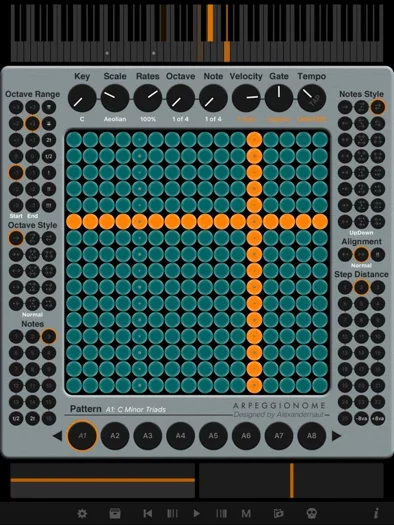
Arpeggionome Pro – Matrix Arpeggiator is a matrix-controlled arpeggiator designed to play with your thumbs. Move vertically to change the rate and horizontally to change pitch, then use the iPad’s motion controls for pitch bend, tremolo, and vibrato.
You can design an arpeggio with the surrounding controls, then reshape it as you play. MIDI output lets it drive other iOS music apps, hardware, or computer instruments. There is also a built-in synth, so it can make sound without another app.
This paid Pro edition is for iPad, with iOS/iPadOS 8 or later listed as its minimum requirement. The developer offers a separate Arpeggionome app for iPhone. It remains a standalone app with Audiobus 3 and Inter-App Audio support; do not assume it is an AUv3 MIDI plug-in.
- Expressive pitch-and-rate matrix with accelerometer control
- MIDI input/output and Ableton Link synchronization
- Choose the Pro edition for iPad rather than buying it for an iPhone
View Price – App Store
5. Fugue Machine Classic
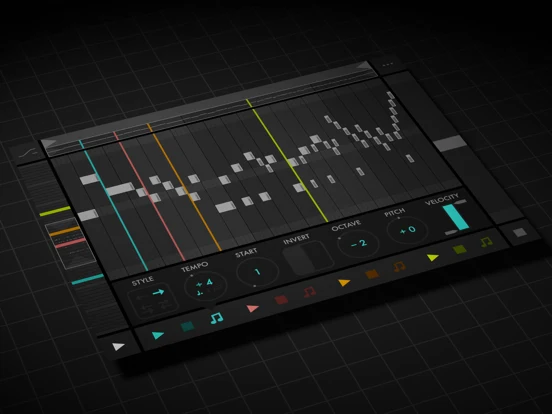
Fugue Machine Classic is a MIDI sequencer that plays one piano-roll pattern with up to four playheads at once. Each can run at a different speed, pitch, and direction, producing related parts from the same melody.
If you already have a collection of iOS synthesizers, it gives you a useful way to develop arrangements for them. Try slowing one playhead for a bass part while another plays the notes backward. Its pattern backup and export tools help keep those ideas organized.
Classic remains available as a paid iPhone/iPad app for iOS/iPadOS 12 or later, with AUv3 MIDI support for compatible hosts. The newer Fugue Machine Rubato is a separate purchase, adding up to eight playheads, time-bending movement, and parameter automation. Classic is still a sensible choice for the simpler four-playhead workflow.
- Control pitch, tempo, octave, and playback direction for each part
- Run multiple Classic instances in an AUv3 MIDI host
- For external instruments, route its MIDI to the synth or hardware you want to play
View Price – App Store
6. Ribn
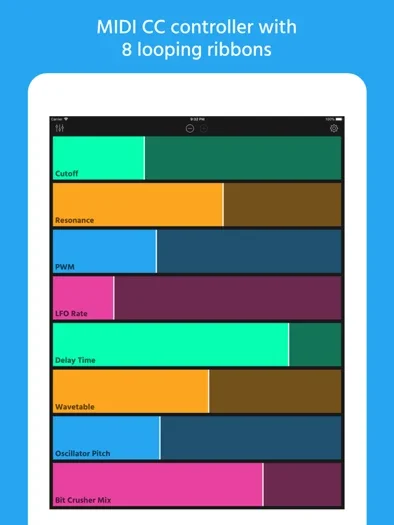
With eight assignable ribbons, Ribn records and loops your finger movements to create repeating modulation. Turn looping off on individual ribbons to use them as ordinary sliders instead.
Each ribbon has its own MIDI channel, CC number, and label. You could control a synth’s filter cutoff with one ribbon and a reverb parameter with another, provided the receiving instruments respond to those CC messages. Settings save automatically, and presets hold three sets of configurations.
Ribn is a paid standalone app for iPhone and iPad running iOS/iPadOS 10 or later. It sends MIDI CC messages only: it does not send notes or generate sound. Connect through virtual MIDI, Wi-Fi, Bluetooth, or a compatible wired interface. A MIDI-to-CV interface is needed to use it with compatible Eurorack gear.
- Choose between one and eight ribbons
- Multiple MIDI outputs and background MIDI sending
- A modulation controller rather than a keyboard for playing melodies
View Price – App Store
7. midiLFOs
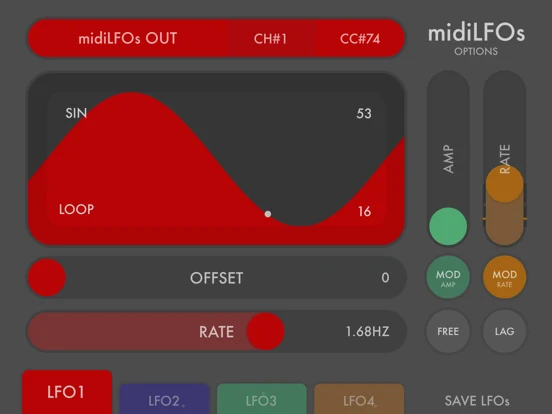
midiLFOs is a MIDI controller app and AUv3 MIDI effect that sends modulation to other apps and hardware synthesizers. Its four independent LFOs produce repeating patterns of 7-bit MIDI CC messages.
The app does not create sound by itself. Use it to move a filter cutoff, pan a hi-hat part, change delay feedback, or automate another parameter supported by your receiving instrument. Each LFO can modulate the rate or amount of another, giving you more varied movement than a single repeating waveform.
This is a paid iPhone/iPad app requiring iOS/iPadOS 11.4 or later. Use it standalone through Core MIDI, or load its AUv3 MIDI effect in a host that supports MIDI effects, such as AUM or Audiobus 3.
- Set the output port, MIDI channel, and CC number for each LFO
- Adjust shape, rate, offset, and lag
- Synchronize with MIDI clock or Ableton Link
View Price – App Store
8. Patch Base
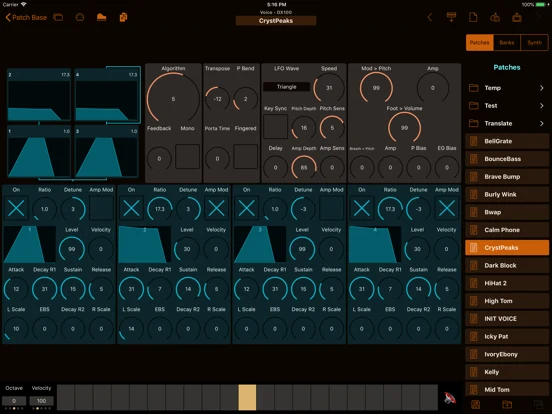
Patch Base is a collection of patch editors and librarians for hardware synthesizers. It gives you an on-screen view of a supported synth’s parameters and helps organize its patches and banks.
Its editors cover instruments from Korg, Roland, Yamaha, Oberheim, and other makers. You can edit sounds in real time, use the on-screen keyboard for auditioning, and back up patches through iCloud. Choose an editor for your exact synth: it is not a universal editor for every MIDI device.
The iPad app requires iPadOS 13 or later and is free to download and try. Full editor access requires an individual editor purchase or an All Access subscription. You also need the supported hardware and a suitable MIDI connection. The developer’s Mac edition is a separate product; its version number and licence should not be confused with the iPad app.
- Real-time editing and patch-bank management
- Individual editor purchases or All Access subscription
- An iPad editor for external hardware, rather than an iPhone synth app
View Price – App Store
9. LK – Ableton & MIDI Controller
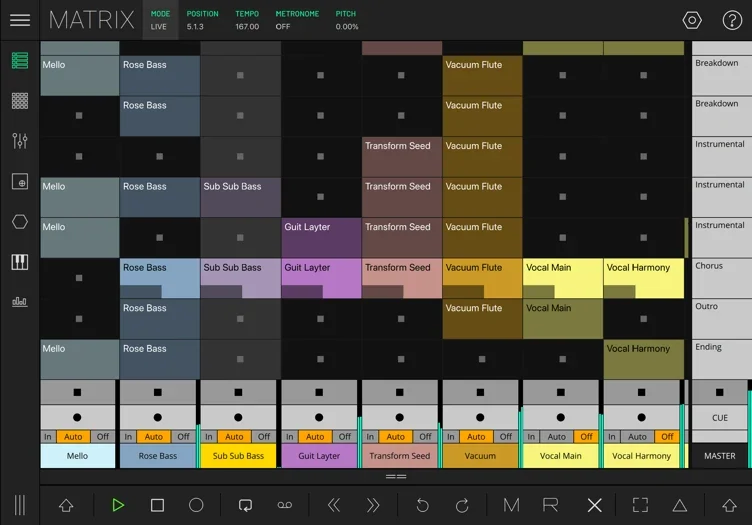
LK – Ableton & MIDI Controller provides touchscreen control of Ableton Live and can also work as a MIDI controller and sequencer without Live. Its Matrix module launches clips and scenes and gives you access to track controls, while pads, keys, and chord tools handle playing.
For the Live connection, install Imaginando’s free UBRIDGE utility on your Mac or Windows computer and set up the LK control surface in Live. Wired USB and Wi-Fi connections are supported. Ordinary MIDI control and AUv3 use do not require an Ableton Live licence.
LK runs on iPhone and iPad with iOS/iPadOS 17 or later. It is free to download, but its modules have time-limited trials and are unlocked through in-app purchases. A free download does not include unrestricted access to every module. It also supports AUv3 MIDI operation in compatible hosts.
- Clip and scene launching, mixer control, and MIDI sequencing
- Custom controls, expressive keyboard, pads, and chord tools
- Live integration requires the desktop helper and a separate Ableton Live installation
View Price – App Store
10. TouchOSC
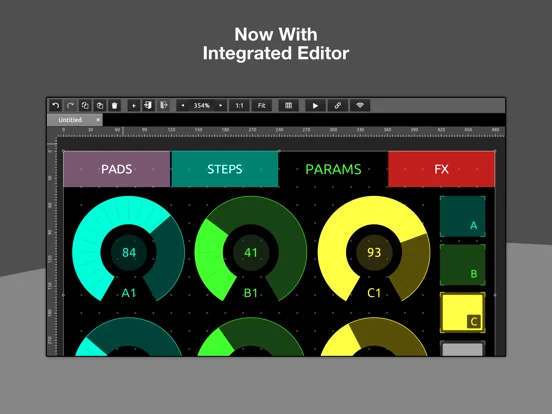
TouchOSC lets you design your own touchscreen controller with knobs, faders, buttons, pads, and other controls. The editor is included in the iPhone/iPad app, so a desktop computer is not required to build a layout.
It sends and receives MIDI and OSC messages over wired or wireless connections, with scripting available for more involved behavior. You can also edit a layout on a computer and synchronize changes across connected devices. This flexibility is useful when the standard layout in a DAW remote does not match your equipment.
The current TouchOSC app requires iOS/iPadOS 13 or later and is a paid App Store purchase. It is separate from TouchOSC Mk1; desktop licences are sold separately from the mobile app. The free TouchOSC Bridge utility can relay MIDI between the app and a computer.
- Integrated editor and customizable MIDI/OSC mappings
- Can control software or hardware without producing its own instrument sounds
- Custom layouts require you to map controls to the receiving app or device
View Price – App Store
11. MIDI Wrench
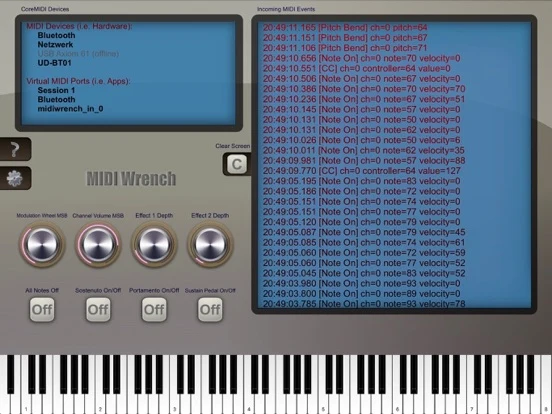
MIDI Wrench is a free MIDI monitor and controller for troubleshooting your setup. Connect a MIDI device and watch the messages it sends, or use the app’s virtual keyboard, buttons, and knobs to send messages back.
It lists hardware and virtual CoreMIDI ports, supports Bluetooth LE MIDI, and lets you filter the incoming event display. The configurable controls send Note On, Note Off, and Control Change messages. You can copy events as text when you need to investigate a mapping or share a diagnostic example.
MIDI Wrench runs on iPhone and iPad with iOS/iPadOS 9 or later. The developer states that it is free and has no ads. It is a standalone utility for connected MIDI equipment and apps, rather than a sound-generating synthesizer or AUv3 instrument.
- Displays CoreMIDI devices and incoming messages in real time
- Virtual keyboard and configurable on-screen MIDI controls
- Best for diagnostics and basic control rather than building a full performance surface
View Price – App Store
12. MIDI Designer Pro X
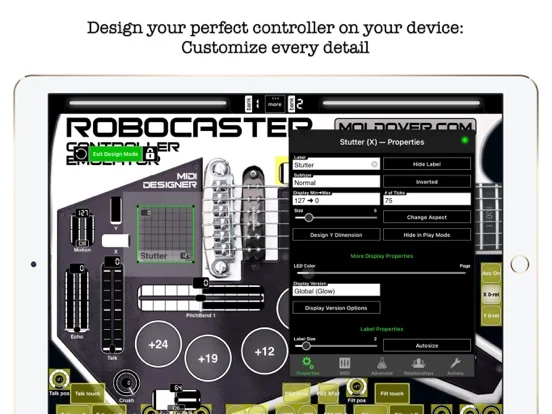
MIDI Designer Pro X is the current continuation of MIDI Designer Pro 2. It lets you build controllers for MIDI-capable hardware and software, or start with layouts from its user community.
You can arrange knobs, buttons, sliders, and XY pads to suit your equipment, including devices that use SysEx. The app controls synthesizers, effects, DAWs, and plug-ins; those instruments and effects are not included in the app. It can run standalone or as an AUv3 MIDI processor in a compatible host.
The current iPhone/iPad download requires iOS/iPadOS 18.6 or later. It is free with a limited feature set, while Premium is a subscription that unlocks broader layout and customization features. Owners who bought Pro 2 before the subscription transition retain access to their pre-version-10 features under the developer’s legacy policy.
- Design a controller or use a community layout
- MIDI over USB, Bluetooth, and network connections
- Check Premium’s platform coverage if you also plan to use the Mac version
View Price – App Store
Conclusion
MIDI controller apps can be a great help, whether you need to play an instrument, control your DAW, or manage a hardware setup. For chord playing, start with ChordPolyPad or ChordUp. For expressive notes without a built-in sound engine, GeoShred Control is a useful free option. Ribn and midiLFOs suit parameter modulation, while MIDI Wrench helps you diagnose connections.
Choose the app for the job and the device you own. An app that sends CC messages cannot replace a note keyboard, and an AUv3 MIDI effect needs a host that supports that format. If you prefer physical keys and knobs, a traditional MIDI controller still offers tactile control that a touchscreen cannot provide.