The 10 Best Drum Machines (2026)

Drum machines come in a lot of styles, shapes, and sizes, so it can be tedious to figure out which one to get, especially if you are not sure exactly what you want from one. This article should help clear things up a bit!
My top recommended drum machine is the Roland TR-8S. The TR-8S is a versatile drum machine for serious musicians and producers.
My second recommended drum machine is the Alesis SR-16, it’s a basic drum machine that does the job and has certainly stood the test of time!
Contents
- The Best Drum Machines (2026)
- 1. Roland TR-8S
- 2. Alesis SR-16
- 3. Arturia DrumBrute Impact
- 4. Korg Volca Beats
- 5. Roland T-8 Beat Machine
- 6. Behringer RD-8 MKII
- 7. Teenage Engineering PO-12 rhythm
- 8. Alesis SR-18
- 9. Singular Sound BeatBuddy 2
- 10. Korg electribe sampler ELECTRIBE2SRD
- What is a Drum Machine and How Does it Work?
- What is the Difference Between a Drum Machine and a midi drum pad?
- What is the Difference Between Analog and Digital Drum Machines?
- What are the various capabilities of a Drum Machine?
- What to Look For in a Drum Machine When Buying?
- Conclusion
The Best Drum Machines (2026)
And now onto the full list:

1. Roland TR-8S
The Roland TR-8S follows the popular TR-8 and combines classic Roland drum models, FM sounds, and imported samples. It’s mainly an improvement over the TR-8 with a lot of new features, sound effects, and editing capabilities added.
Pros
- Roland’s ACB drum sounds are included as standard
- Multichannel USB audio
- Hands-on sequencing and live arrangement workflow
Cons
- Some usability is compromised in order to provide more advanced features
- Cannot sample external audio directly
- Pricey
This drum machine provides an incredible depth of effects that may be added channel by channel. With the TR-8S, you get more than just drum sounds, you also get synth-type sounds. Thus, this drum machine might be your full live production setup in some electronic music styles, for example!
On the downside, the unit is a bit pricey compared to other devices on the list. Additionally, in order to provide more advanced features, some usability is sacrificed. It stores 128 patterns with variations and supports SD-card backup, but external audio must be recorded elsewhere before you import it as a sample.
| Type | Digital |
| Sounds | Patterns, tracks, samples, effects |
| Connectors | 8 analog outputs, MIDI, stereo external inputs, trigger output |
| Other Features | Step Sequencer |
The biggest difference between the TR-8 and the TR-8S is that the TR-8S looks very different. Bigger, more modern with extra knobs and buttons. It is also MIDI compatible, which means you may link it to other music equipment to match the tempo or record externally.
2. Alesis SR-16
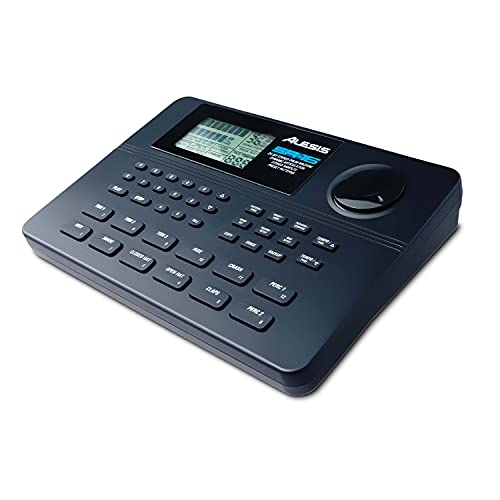
The Alesis SR-16 is one of the most known drum machines ever produced for studios. From its debut in 1990, this electronic drum machine has evolved in tandem with the electronic music scene. It is a classic, and for a reason.
Pros
- Decent sounds for live performances
- Simple and portable drum machine
- Lightweight
Cons
- Pattern handling is limited
- No backlit screen
- The velocity-sensitive pads are small
The sounds that are in the Alesis SR-16 are very impressive, and it has a lot to choose from. This seemingly basic and simplistic drum machine has been used for well over twenty-seven years, and that speaks volumes of how it was used by musicians.
When it comes to drawbacks, the Alesis SR-16’s velocity-sensitive pads are considered quite small. Other than that, the pattern handling is limited as well as the lack of a backlit screen.
| Type | Digital |
| Sounds | Patterns, tracks, samples, effects |
| Connectors | Four 1/4-inch outputs, MIDI In and Out/Thru, two footswitch inputs, headphone output |
| Other Features | 233 sounds, 12 velocity-sensitive pads, step programming |
The kick drums, snare, percussion, and all rhythms you can produce with this drum machine in many genres are amazing. With a very simple interface, though frankly not that easy to use, it’s certainly possible to get beautiful loops from this device.

3. Arturia DrumBrute Impact
The Arturia DrumBrute Impact is an analog drum machine for serious music producers. It combines a flexible sequencer with ten analog percussion sounds and output distortion.
Pros
- An affordable analog drum machine
- Superior user interface
- Color sound shaping and output distortion
Cons
- Individual outputs are connected through mini-jacks
- Some parameters need a wider range
It has a lot of connections, MIDI In/Out, USB MIDI, and four group outputs, just to name a few, which is fantastic for recording or outputting to a mixing desk for live performance.
One thing to note here is that the group outputs use 1/8-inch connectors rather than 1/4-inch connectors, which some might find annoying if you have to use different connectors and/or cables. Additionally, some parameters need a wider range, which is not a huge dealbreaker, but still.
| Type | Analog |
| Sounds | Ten analog drum sounds, Color shaping, output distortion |
| Connectors | Four 3.5 mm group outputs, MIDI In/Out, USB MIDI, 1/4-inch mix output, 3.5 mm headphone output |
| Other Features | Step Sequencer, polyrhythm mode, Color sound shaping and output distortion |
My favorite feature is the “Color” option, which changes the color of each sound, and the FM drum. This means you may change it into a variety of other sounds. Finally, the master bus distortion roughens and harshens the sound, providing that distinctive “brute” sound!

4. Korg Volca Beats
The Korg VolcaBeats is a very versatile and accessible analog rhythm machine. It combines six analog voices with four PCM voices and a 16-step sequencer. Its PCM sounds are built in; you cannot load your own samples.
Pros
- Easy to use
- Portable
- Very Affordable
Cons
- The sequencer steps are limited
- No USB connection
- The snare sound is inferior to other similarly-priced drum machines
When creating sequences with the sounds on the Korg Volca Drum Machine, you can easily tweak them with the onboard controls. You can also record those adjustments as well as the stutterer, speed changes, and layer on top of them.
On the negative side, the sequencer steps are rather limited, there is no USB connectivity, and the snare sound is considered inferior when compared to other drum machines with a similar price tag range.
| Type | Analog |
| Sounds | Samples, effects |
| Connectors | MIDI In, 1 x 1/8“Headphones, Sync I/O 3.5 mm |
| Other Features | Loop and step sequencer |
The Korg VolcaBeats also has a built-in speaker and battery operation, so you can easily take your music with you wherever you go. That’s what makes this a great portable drum machine.

5. Roland T-8 Beat Machine
The Roland T-8 is a small drum and bass machine for building electronic grooves away from a full studio. Its digital ACB engine models classic Roland sounds, with six drum tracks and a separate TB-303-style bass part.
Pros
- Built-in rechargeable battery
- Drums and bass in one compact box
- USB-C audio and MIDI
Cons
- Cannot import your own samples
- Small controls and shared functions
The 32-step sequencer stores 64 patterns. Probability and sub steps help vary repeated rhythms, while dedicated bass controls let you adjust the tone as the pattern plays.
Delay, reverb, overdrive, and sidechain compression give you several ways to shape a groove. The T-8 is useful for quick electronic sketches, especially when you want a bass line alongside the drums.
| Type | Digital ACB modeling |
| Sounds | Six drum tracks and one bass track |
| Connectors | USB-C audio/MIDI, TRS MIDI In/Out, sync In/Out, mix input, headphone/line output |
| Other Features | 32-step sequencer, rechargeable battery |
Choose it for portability and hands-on pattern making. It has a narrower drum palette than the TR-8S, and it is not a sampler or an analog drum synthesizer.

6. Behringer RD-8 MKII
The RD-8 MKII is Behringer’s take on the classic TR-808. With their recreated BA662 VCA circuit, it produces great snappy sound, just as the TR-808. It has a lot of connectivity inputs and outputs, which makes it great for producers and enthusiasts.
Pros
- Great connectivity options
- Powerful with a lot of features
- Good for live performances
Cons
- Bulky design
- Not as portable as its direct rivals
What Behringer has accomplished with the RD-8 MKII is bringing the sounds of some of the most iconic drum machines, adding a lot of features, and slapping a very affordable price tag on it. It really does offer a lot for a very competitive price.
Of course, it is not without a few setbacks. This includes the rather bulky design of the drum machine and the not-so-portable nature when compared to some of its rivals.
| Type | Analog |
| Sounds | Patterns, tracks, samples, effects |
| Connectors | 11 analog outputs, MIDI In/Out/Thru/USB, 1/4″ analog input, 1/4″ TRS (main/mono) analog output |
| Other Features | Step Sequencer, Wave Designer, Dual-mode Filter |
The 64-step sequencer can store up to 256 patterns and 16 songs, and it can create incredibly complex song arrangements. This all leads to a much-improved workflow alongside one of the best step sequencers on the market.
The MKII is the version to choose here. Its revised circuitry keeps the same analog 808-style role, while the Wave Designer and dual-mode filter add sound-shaping options. It is a large studio instrument, and current ordering may involve a wait for stock.

7. Teenage Engineering PO-12 rhythm
The Teenage Engineering PO-12 Rhythm machine comes with 16 sounds and patterns, all of which sounds pretty cool. It also has a built-in speaker, and LCD display and is powered via 2 standard AAA batteries.
Pros
- Affordable
- The animated display looks great
- Amazing portability
Cons
- No MIDI or USB connection
- Steep learning curve
- The controls aren’t intuitive
If you’re looking for an inexpensive pocket-sized, battery-powered drum machine, the Teenage Engineering PO-12 features a lot of fun sequencing and parameter adjusting capabilities.
Naturally, for affordable entries like this one, there are bound to be a few drawbacks. There is no MIDI or USB connection, and the small interface relies on button combinations that take time to learn.
| Type | Digital |
| Sounds | Patterns, effects |
| Connectors | Line input and output – 3.5 mm jack |
| Other Features | Step Sequencer, Integrated clock, and alarm clock |
The Engineering PO-12 is one of the best pocket operators out there, and since it’s very affordable, there is no reason not to try it out if you are interested!

8. Alesis SR-18
The Alesis SR-18 is a drum machine for musicians who want drum, percussion, and bass backing without opening a computer. It takes over this accompaniment role from the discontinued BOSS DR-880, with velocity-sensitive pads and a library of acoustic and electronic sounds.
Pros
- Drum, percussion, and bass parts
- Battery or mains operation
- Footswitch control for accompaniment
Cons
- Cannot load your own drum samples
- No built-in guitar amp modeling
You can build patterns with A and B variations and fills, then arrange those patterns into songs. That is useful for practicing an instrument or sketching an arrangement before recording a band.
The SR-18 also includes reverb, EQ, and compression. Its instrument input lets you play along, but it does not replace the DR-880’s COSM guitar effects. Use your own amp or processor when you need those tones.
| Type | Digital, sample-based |
| Sounds | Drums, percussion, and bass |
| Connectors | Stereo main outputs, auxiliary output, headphones, instrument input, MIDI In/Out, footswitch inputs |
| Other Features | Pattern/song sequencing, battery operation |
The SR-18 suits songwriting and conventional backing patterns more than live electronic sound design. It gives the SR-16 user a wider accompaniment toolkit, while the simpler SR-16 remains my budget recommendation.

9. Singular Sound BeatBuddy 2
The BeatBuddy 2 is a drum machine pedal for guitarists and other performers who want to control their accompaniment with their feet. The main appeal is still being able to trigger fills and transitions while keeping both hands on your instrument.
Pros
- Hands-free fills and transitions
- Larger 2.4-inch screen
- Full-size MIDI connections
Cons
- Pricey for a simple practice setup
- Requires external power
The second generation adds two customizable on-pedal buttons and an improved screen. You can connect an expression pedal to control tempo, volume, or velocity, which gives a solo performance more room to change dynamically.
It remains a different kind of instrument from a desktop step sequencer. Choose it for playing along and performing with backing drums; choose a pad-based machine if programming beats with your fingers is the priority.
| Type | Digital drum pedal |
| Sounds | Sample-based drum accompaniment |
| Connectors | Stereo inputs/outputs, full-size MIDI In/Out, headphone output, footswitch/expression connections |
| Other Features | SD card storage, customizable pedal controls |
There is a headphone output for quiet practice, and the recessed SD-card slot keeps the card out of the way. The full-size MIDI ports also make this version easier to connect to a compatible performance rig.

10. Korg electribe sampler ELECTRIBE2SRD
The Korg ELECTRIBE2SRD sampler is a sample-based production drum machine that allows you to create beats very quickly. It has 16 velocity-sensitive multi-LED pads, which give you great visual feedback when creating patterns.
Pros
- Great sampling capabilities
- You can import waveform and resample
- High-quality preset samples
Cons
- A bit pricey
- Sequencing is not as good as direct rivals
It has a huge selection of effects to add to the parts and patterns you create.
| Type | Digital |
| Sounds | Patterns, tracks, samples, effects |
| Connectors | 1/4” TS input, 1/4” TRS output, 1 x USB Micro-B, MIDI In/Out, 1 x 1/8“ headphone jack |
| Other Features | Step Sequencer |
You may also select from 25 different groove types that mimic the playing style and rhythmic feel of percussion instruments. The ELECTRIBE2SRD can import your own samples and resample its output. This is the red sampler model, rather than the blue synthesizer Electribe.
What is a Drum Machine and How Does it Work?
A drum machine is an electronic musical instrument that creates drum sounds. Drum machines can mimic the sound of real drums or create completely new and unique drum sounds.
Most drum machines have a built-in step sequencer, which allows the user to create drum patterns by pressing buttons or keys in a specific order. The drum patterns are then played back automatically by the machine.
Drum machines can be either analog or digital. Analog drum machines use analog circuitry to create their sounds, while digital drum machines use digital samples of real drums or other sounds.
What is the Difference Between a Drum Machine and a midi drum pad?
Drum machines have sound generators that create drum sounds. Drum machines usually have a built-in step sequencer for creating drum patterns. MIDI drum pads do not have sound generators and cannot create drum sounds on their own.
MIDI drum pads are drum controllers that send MIDI signals to a drum machine or other MIDI devices. MIDI drum pads usually have velocity-sensitive pads that can be used to create drum sounds.
What is the Difference Between Analog and Digital Drum Machines?
Analog drum machines use analog circuitry to create their sounds. Analog drum machines often have a “warm” sound because of the way that they process audio signals.
Digital drum machines use digital samples of real drums or other sounds. Digital drum machines can often create more realistic drum sounds than analog drum machines.
When buying a drum machine, you should consider what type of sounds you want to create, how easy the machine is to use, and how much you are willing to spend.
What are the various capabilities of a Drum Machine?
Drum machines can have various capabilities, depending on the model. Some drum machines can record your drum patterns and play them back. Other drum machines have a live mode, which allows you to play your drum patterns in real time.
Some drum machines also have MIDI capabilities, which allow you to connect the drum machine to other MIDI devices. This can be used to trigger sounds from other devices or to control the sound of the drum machine from another device.
Headphone connectivity is another important feature to consider when buying a drum machine. This allows you to listen to your drum patterns without disturbing others. USB connectivity is also a useful feature, as it allows you to connect the drum machine to a computer.
What to Look For in a Drum Machine When Buying?
If you want to create realistic drum sounds, you should look for a digital drum machine. If you want more analog sounds, you should look for an analog drum machine.
Ease of use is important if you are new to using drum machines. Some drum machines have complicated step sequencers that can be difficult to use. Other drum machines have simpler step sequencers that are easier to use.
Naturally, you should consider the portability of the device, the connectivity options, how many sound/samples are on the drum machine, and lastly, the price of the device.
Conclusion
Once you figure out how portable you need your drum machine to be, which type of sounds are you looking for (digital/analog), and how simple or complex you need the step sequencer to be, this list will help you to decide which one is the right one for you. Also, other important things to keep in mind are the connectivity inputs and outputs.
My top drum machine pick is the Roland TR-8S, a high-quality drum machine for serious musicians and producers.
My budget drum machine pick is the Alesis SR-16, an affordable option for those on a budget who are after a good quality device.