The 5 Best Pan Flutes (2026) for a Warm and Rich Sound

The Pan flute is a beautiful old musical instrument. It persists as a beautiful addition used in a variety of music everywhere around the globe with different names and sizes but using the same principle.
You’ve most likely heard this beautiful-sounding instrument somewhere by now. The name ‘Pan flute’ comes from Ancient Greece and the legend of the creation of this flute by the Greek god ‘Pan’.
I’ve made a list of top pan flutes to help you with choosing the right one considering your preferences, as there are a lot of them that you can buy online. The choices below cover small learning instruments, traditional reed and bamboo builds, and a resin alternative.
My main recommended pan flute is the Peru Treasure 15-Pipe Bamboo Pan Flute. A compact and nice-sounding product for anyone interested in the instrument.
My second recommended pan flute is the Plaschke R08 C Pan Flute. It’s a decent budget pan flute if casual playing is all you intend to do.
Contents
- The 5 Best Pan Flutes (2026)
- 1. Peru Treasure 15-Pipe Bamboo Pan Flute
- 2. Plaschke R08 C Pan Flute
- 3. Plaschke R12 C Pan Flute
- 4. Wind Melody 18-Pipe Resin C Pan Flute
- 5. 15-Pipe G-Key Bamboo Pan Flute (Right-Hand)
- How does a Pan Flute Work?
- Where is the Pan Flute mostly used?
- What are the best Pan Flute brands?
- What to look for in a Pan Flute when buying?
- Conclusion
The 5 Best Pan Flutes (2026)

Let’s compare these in more detail.

1. Peru Treasure 15-Pipe Bamboo Pan Flute
This Peru Treasure pan flute is a good starting flute that sounds good. It’s a small and compact 15 pipe pan flute that is quite easy to play and learn on. The small size makes it easy to carry, so there is no limit to where you can play it.
Pros
- The small size makes it easy to carry around
- Can be tuned
- Comes with a case for storage
Cons
- Might be considered too small for some
Being made of bamboo wood, it has a pretty solid construction and a traditional design. Plus, it comes with an artsy Peruvian case that captures the vibes of South America and keeps it safe. This is nice as you will be able to keep it around for a long time.
This is a curved pan flute. The shortest pipe is 2” while the longest is about 7” and a quarter. While its factory tuning is set to C, you can tune it as you desire.
| Dimensions | 9 x 9 x 1.5 inches |
| Pipes | 15 |
| Tuning | C |
| Tunable | Yes |
| Material | Bamboo wood |
All in all, this is a pretty good beginner pan flute and can be considered a good value for money.
2. Plaschke R08 C Pan Flute
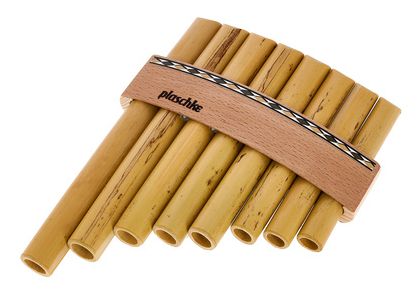
If you want a small pan flute for learning a few tunes, the Plaschke R08 C is a sensible starting point. Its eight pipes cover one octave, so there is less distance to navigate than on a wider multi-octave instrument.
Pros
- Handmade reed construction
- Compact curved layout
- C tuning
Cons
- Limited one-octave range
This is a handmade reed instrument from Italy, with a curved Romanian-style layout. It is tuned in C and treated with natural oils to finish and protect the natural material.
The limited range is also its main drawback. An octave is enough for breathing, articulation and simple melodies, but many tunes will need notes beyond its eight pipes. If you already know you want to learn more demanding music, look at a larger pan flute instead.
For casual playing and a first introduction, I would choose this compact instrument over a larger model bought mainly for its pipe count. You can concentrate on producing clear notes before deciding whether you need more range.
| Pipes | 8 |
| Tuning | C |
| Range | C5–C6 |
| Material | Reed |
| Origin | Made in Italy |
3. Plaschke R12 C Pan Flute
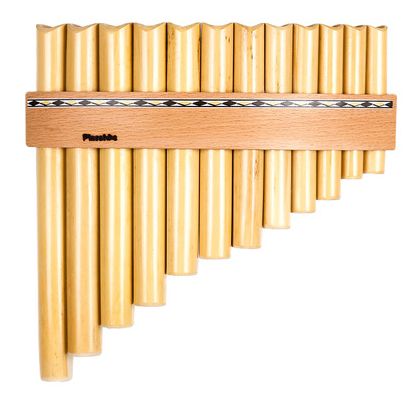
The Plaschke R12 C is a handmade option for someone who wants a compact natural-reed pan flute with a little more musical room than an eight-pipe model. Its twelve pipes cover A4 to E6 in the maker’s C-tuned layout.
Pros
- Handmade reed construction
- Compact curved layout
- C tuning
Cons
- Less range than a full-size concert pan flute
It uses a curved Romanian-style construction and is made in Italy. The reed is treated with natural oils, and the compact curved shape keeps the pipes close together while you move between notes.
Twelve pipes give you more room for melodies while keeping the instrument smaller than the broad multi-octave models. It is a reasonable middle step for a learner who wants something portable but expects to outgrow a one-octave instrument.
The range is still limited compared with a full-size concert pan flute. The A4 to E6 range suits a compact learning instrument, though full-size concert models cover more demanding music.
| Pipes | 12 |
| Tuning | C |
| Range | A4–E6 |
| Material | Reed |
| Origin | Made in Italy |

4. Wind Melody 18-Pipe Resin C Pan Flute
This Wind Melody pan flute, first of all, stands out with its unique non-wooden build. It’s made of resin. Second, it is a very good beginner instrument that one can spend a lot of time learning.
Pros
- Resin pan flute makes for easy learning
- Tunable with a wide tonal range
- Great aesthetics
Cons
- Less range than a full-size concert pan flute
The resin construction offers a different feel from natural reed or bamboo. Like other pan flutes, it sounds when you blow across the openings; it does not use a vibrating reed. The notes (whole and half notes) are quite clear and have a whistle-like sound.
There are 18 tubes on this, tuned in the key of C major. The number of pipes gives a learner more room for melodies than an eight-pipe starter instrument.
| Dimensions | 13.54 x 11.06 x 0.98 inches |
| Pipes | 18 |
| Tuning | C |
| Tunable | Yes |
| Material | Resin |
Unless you’re an expert who will settle at nothing but a professional wooden pan flute, this Wind Melody pan flute is a very nice instrument to play.
5. 15-Pipe G-Key Bamboo Pan Flute (Right-Hand)
The SUTILA traditional Chinese pan flute is a vibrant woodwind instrument that’s great for beginner to intermediate use. It’s well-rounded in its made and vibrant sound.
The linked model is the right-hand version. Hand orientation changes the order of the pipes, so this specific configuration matters when you are learning or following a teacher.
Pros
- Right-hand pipe layout
- Fifteen pipes in G
- Good for everyone who’s not a professional
Cons
- A bit pricey for a mid-range pan flute
Due to its solid construction, it allows for really smooth airflow. This allows for all of its 15 tones to be clear and characteristic. The fifteen-pipe layout offers a useful compromise between a small starter instrument and a larger pan flute.
The standard tuning is the key of G major. A separate tuner is useful for checking the notes while you practice.
| Dimensions | 10.1 x 10.1 x 2.4 inches |
| Pipes | 15 |
| Tuning | G |
| Tunable | Yes |
| Material | Bamboo wood |
For a starter or intermediate player looking for a right-hand G-key instrument, this is a compact option to consider.
How does a Pan Flute Work?
A pan flute is a series of end-blown flutes tied together to form an instrument. These flutes are arranged in ascending order concerning their size.
Using pursed lips, you blow into the instrument and move sideways. Blowing across a pipe’s open edge sets the air inside it vibrating. Moving your mouth between pipes selects different notes; the length of each air column determines its pitch. Different lengths mean different tones. The tuning is most often in the diatonic scale.
There are also various techniques on how to play them, while the optimal still stands, there is a tilt technique that is quite unique but difficult to master.
Where is the Pan Flute mostly used?
The pan flute is an age-old woodwind instrument found in many cultures. Historically, it was played by the Greeks and as Antara in tribal music from Africa, South America, and even Asia.
In modern-day usage, it still retains its tribal vibe, extensively used in folk and regional music. It has also found a place in orchestral music. The pan flute can be heard in churches, camps, and other various ceremonies that involve people, even more modern ones that include fundraising and other similar events.
What are the best Pan Flute brands?
Since pan flutes aren’t the most common instruments, you won’t find one made by most mainstream brands. However, there are plenty of professional or concert series pan flute companies today.
Plaschke makes handmade reed instruments in several sizes. Peru Treasure and Wind Melody also offer the beginner options covered above. With them, you will find both beginner and intermediate pan flutes.
Some honorable mentions would be Ramos, MoonAngel, Nai, and the Zampona panflute. Still, the best brands can be considered those who use the best material, in my opinion. Reed and bamboo are traditional choices, while resin is a practical alternative. Material alone does not establish the tuning, finish or suitability of a particular instrument.
What to look for in a Pan Flute when buying?
As a beginner, you want your pan flute to, first and foremost, sound nice. It should be easy to play as well since it can make or break the whole learning process.
Then comes factors like the number of pipes and the tunability of the instrument. This decides the range of sounds that you can get out of your pan flute.
Check the finish around the pipe openings and the security of the binding. Rough edges can make playing uncomfortable, while a clean, smooth mouth surface helps you move between notes.
Lastly, you want to look at the price as well. Unless you’re a professional or planning to be one, you don’t want to spend a lot of money for what essentially will be casual playing. Luckily, there are a lot of inexpensive, but good pan flutes out there.
Conclusion
A pan flute is a traditional, folksy woodwind instrument that is fun to learn and even more so to play. There are many good pan flutes available today, so it shouldn’t be hard for you to find one.
The Peru Treasure 15-Pipe Bamboo Pan Flute is a very nice overall instrument for beginners to play and has that all-in-one factor.
If you’re on a budget, the Plaschke R08 C Pan Flute is another good option to consider.