432 Hz vs 440 Hz (Differences, Tuning, Which Sounds Better)

440 Hz is the standard accepted pitch reference for tuning musical instruments. 432 Hz is an alternative pitch argued by some to be superior due to personal preferences or spiritual beliefs.
If we didn’t have a standard pitch reference then musical instruments would sound out of tune with each other. In the past decade, there has been much debate over whether 440 Hz is better or 432 Hz is, mostly fuelled by a massive amount of misinformation surrounding support for 432 Hz.
This has resulted in some people believing that 432 Hz is the ‘frequency of the Universe’ with spiritual benefits and esoteric healing powers, among other things (check out this acoustics explanation for the science behind frequency).
With all that aside, we should let our ears decide which we prefer!
Contents
What is 432 Hz
432 Hz is an alternate tuning system for musical instruments, which is slightly lower than the international standard of 440 Hz tuning.
432 Hz/440 Hz refers to the tuning of the A note above Middle C.
One argument for 432 Hz is that it supposedly makes every C an exact whole-number frequency. That does not follow from A4 = 432 Hz alone. Using the standard equal-temperament frequency relationship, C4 comes out at about 256.87 Hz, rather than exactly 256 Hz. The tuning system matters as well as the reference pitch. But does having a neat-looking number really make any difference to how music sounds?
Why do some people prefer 432 Hz?
Some people believe that music from instruments tuned to 432 Hz is warmer and easy on the ears. Others find it to have a brightness that brings mental clarity.
The biggest proponents of 432 Hz can be found in meditation and relaxation music who boldly claim that it is harmonically richer and ‘in-tune’ with nature.
What does 432 Hz sound like?
As expected, 432 Hz sounds slightly lower in pitch than 440 Hz.
Check out the videos below to hear the differences in pitch. Paul Davids, a famous YouTuber, did a great video where he plays the same tunes in 432 Hz and 440 Hz side by side to let your ears be the judge.
Adam Neely also gave his take on the two frequencies in this video.
What note is 432 Hz?
With this reference pitch, A4, the A above middle C, is set to 432 Hz. The other notes still have their own frequencies, so it does not mean that every note in a song vibrates at 432 Hz. The useful distinction is between the chosen tuning reference and the pitches you actually play.
Rick Beato does a great job in this video explaining the deal with A = 440 Hz and A = 432 Hz.
What is 440 Hz?
Musicians have used different reference pitches in different places and periods, so a historical performance may use a different tuning from a modern one. Today, ISO 16 specifies 440 Hz for the A above middle C. That is a shared reference for tuning, rather than a rule that every ensemble must choose the same pitch.
The A above middle C on the piano is also known as A4. Its frequency is 440 Hz when you use that reference, or 432 Hz when you choose the lower one. Hertz, abbreviated Hz, measures cycles per second and is named after physicist Heinrich Hertz, a pioneer of electromagnetic radiation.
A tuning fork supplies a steady reference note that other instruments can match. The important thing is to know which reference it supplies: choosing a fork, tuner, or app set to a different A4 frequency will change the pitches you tune to. Agree on that reference with the other musicians before you start.
While the International Organization for Standardization set a standardized pitch of 440 Hz for A4, this isn’t universally accepted for all orchestras.
Orchestras and historical ensembles may use different reference tunings. If you are playing with one, ask which reference it uses rather than assuming that its A is 440 Hz. Even a small change can matter when you try to match a fixed-pitch instrument or a recording.
A440 corresponds to an audio frequency of 440 Hz for A4, rather than for every note. It is the standard musical pitch specified in ISO 16:1975. When a tuner displays A = 440, it is showing the reference from which it calculates the other notes.
The reference pitch applies whatever key you play in. If you change A4 from 440 Hz to 432 Hz while keeping the same temperament, every note moves down by the same proportion. The intervals between those notes remain the same.
432Hz vs 440 Hz – 4 Different Opinions

There have been long-standing debates on which frequency is the better of the two, and just like any other debate, there are varying opinions on this as well.
Instead of presenting one side of the argument, we’re going to show you 4 different (and conflicting!) arguments that you will see repeated online.
These arguments are:
- Argument 1 – ‘Live and Let Live’. They’re both valid. It’s a matter of preference. End of story!
- Argument 2 – Stick with 440 Hz because it’s the standard. 432 Hz makes things awkward.
- Argument 3 – 432 Hz has spiritual significance.
- Argument 4 – 432 Hz is nonsense!
Let’s go through the reasoning behind each argument:
Argument 1 – ‘Live and Let Live’. They’re both valid. It’s a matter of preference. End of story!
Both frequencies are fine. They are both valid, and it’s a matter of personal preference whatever you prefer. I like this argument. In fact, I think it should be the mindset when it comes to most differences in life!
I’m completely fine with people choosing 440 Hz or 432 Hz based on their own personal preferences or beliefs. Tuning frequencies tend to be quite arbitrary. I don’t think we need to speak in ‘absolutes’ about this topic, because most arguments between these tuning frequencies are very subjective.
However, just because you like the sound of 432 Hz does not mean that you should spread misinformation about it! If arguing in favor of 432 Hz, make sure you get your facts from reliable sources.
Argument 2 – Stick with 440 Hz Because it’s the Standard
440 Hz is the standard tuning. We should follow the standard. 432 Hz just makes things awkward because any instruments tuned in this fashion won’t be in tune with most other instruments.
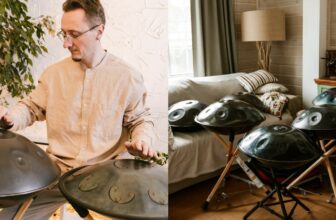
This is particularly tricky with instruments that cannot be tuned, for example, a steel tongue drum tuned to 432 Hz will sound completely out of tune with other standard instruments tuned to 440 Hz.
Countless millions of musical instruments, tuners, and musical software all use 440 Hz as the standard. Switching to 432 Hz at this point would be quite unfeasible, even if there was any solid reason to do it.
Argument 3 – 432 Hz has Spiritual Significance
Others go as far as to say that A432 has spiritual healing properties, which are quite contrary to what they believe are agonizing and irksome properties of A440. Thus, A432 is often preferred by people for meditation, healing, and spirituality.
Another reason why some people prefer 432 Hz over 440 Hz is that they believed it to be an ‘auspicious’ frequency that can help immensely in the spiritual development of listeners. Proponents of this frequency believe that it helps develop inner peace because it is seemingly clearer than A440.
Some small studies have investigated the difference. A 2019 double-blind crossover pilot study involved 33 healthy volunteers listening to the same music at the two tunings. It reported some short-term differences in heart rate and listening experience. That is limited evidence from a small experiment, not proof of healing powers or of a benefit for every listener.
If people have a better experience listening to music at 432 Hz then that is great for them! However, supporters of this as a pitch reference have been let down by misinformation about 432 Hz and its correlation with history and nature. This acoustics reference explains how frequency, pitch, and harmonics actually work.
There isn’t really any solid evidence that makes A432 better than A440. I think we need to make it clear that most of the arguments in favor of 432 Hz are fiction.
However, if a person genuinely gets more enjoyment from A432 for their own personal listening and spiritual practice then why would you want to take this away from them?
Argument 4 – 432 Hz is Nonsense!
Many others completely reject the argument that 432 Hz is superior to 440 Hz as a pitch reference, mostly because the 432 Hz side of the argument is often shrouded in misinformation.
Also, keep in mind that the studies and reporting of people’s personal preferences between the frequencies may be extremely biased in this regard. For example, those that practice meditation may subjectively believe that they prefer 432 Hz when they hear this frequency, solely because they have been previously primed to believe that it’s superior through people and publications that they’ve been influenced by.
Those that reject the 432 Hz debate generally push for facts. In this case, objective blind tests between large numbers of people on their preferences between 432 Hz and 440 Hz are the only tangible option.
However, even if the results were to swing heavily of a preference towards 432 Hz, those that reject the spiritual significance arguments are always going to argue that the results are purely coincidental and that ‘correlation does not imply causation’.
How to tune instruments in 432 Hz?
Following the current standard, most instruments are tuned in 440 Hz and more tuners have it as the default setting.
However, some tuners allow you to switch frequencies and tune your instrument to 432 Hz. This option applies to many chromatic tuner pedals, clip-on tuners, and tuning apps on your smartphone.
How to tune a guitar to 432 frequency?

A chromatic tuner or an app displays the tuning standard on its screen. In the clip-on tuners, this is usually in a smaller font above or below the note.
Apps and tuners may allow you to change the frequency via the settings button to whatever you desire. You can toggle it up or down from the standard 440 Hz and set it to 432 Hz.
How to measure hertz in music?
To check a sustained musical note, use a tuner or an audio spectrum analyzer that can identify its fundamental frequency. A spectrum can also show harmonics above that fundamental, so its tallest peak is not always the note you need. An ordinary multimeter does not measure airborne sound directly; it would need a suitable electrical signal and measurement range.
If you search for apps on Play Store, you’ll find options like Spectroid or Audio Frequency Counter that are ‘real-time’ audio spectrum analyzers that use the microphone of your mobile to convert the sound wave and display the frequency.
How to convert music to 432 Hz
Online conversion tools like 432Hzconverter.com offer a quick way to shift a recording. The important condition is that the original really uses A4 = 440 Hz. To move that reference to 432 Hz, lower the whole recording by about 31.77 cents, or 1.818%. Merely changing a file’s label or sample-rate metadata does not reliably retune the music.
You can also do this in an audio editor such as Audacity. Its Change Pitch effect lets you enter a frequency change from 440 to 432 Hz or the equivalent percentage while keeping the tempo. Work on a copy and preview the result. If the original recording uses a different reference, find that first rather than automatically applying the 440-to-432 shift.
How to play synths and VST/AU plugins in 432 Hz?
For synths such as Sylenth, FabFilter Twin, or Zebra, look for a global tune control or suitable oscillator fine-tune settings. Lower an A440 reference by about 31.77 cents, using a negative setting. If you adjust oscillators individually, apply the shift to every pitched oscillator and instrument, including layered sounds, so they stay in tune with one another.
In Kontakt’s Classic view, open the Master Editor and use Master Tune to change the reference from its default A4 = 440 Hz. The Kontakt manual explains this control. Check the tuning of the loaded instrument as well, especially when combining sampled instruments with other synths or a backing track.
Summary
432 Hz and 440 Hz are two different reference frequencies for A4. ISO 16 specifies 440 Hz as standard musical pitch; 432 Hz is an alternative you can choose. Historical tunings varied, so 432 Hz should not be described as a single standard that all musicians followed for six centuries.
People who prefer 432 Hz argue that it sounds more natural and pure. Some artists prefer playing their musical compositions at this frequency because they believe it has spiritual properties while others play them at 440 Hz simply due to habit or because they don’t even know there’s a difference.
Following the current standard, most instruments are tuned in 440 Hz and more tuners have it as the default setting. However, some tuners allow you to switch frequencies and tune your instrument to 432 Hz. This option applies to many chromatic tuner pedals, clip-on tuners, and tuning apps on your smartphone.
We play music because it ‘resonates’ with us. Musicians may eventually stray from the A440 system to explore other ideas just like every guitarist will search past the EADGBE tuning to explore uncharted territories!
However, keep in mind that 440 Hz is here to stay and the world is not going to go switching to 432 Hz any time in the near future, particularly when the main support for this pitch reference is driven by misinformation!