The 6 Best Uni-Vibe Pedals of 2026

Uni-Vibe-style pedals add a pulsing swirl to guitar parts, but their controls, routing, and expression options suit different pedalboards. These six cover simple and adjustable setups.
My top recommendation is the DryBell Vibe Machine V-3, a compact photocell-based pedal with input-impedance options and trimmers for adapting it to your rig.
My budget recommendation is the MXR M68 Uni-Vibe Chorus/Vibrato, which offers straightforward Speed, Level, and Depth controls plus a switch between chorus and vibrato.
Contents
The Best Uni-Vibe Pedals (2026)
Traditional optical construction with external rate control

1. DryBell Vibe Machine V-3
The DryBell Vibe Machine V-3 is my first pick for a player who wants a compact photocell-based vibe with room to adapt it to a particular guitar and pedalboard. Speed and Intensity handle the main movement, while the Chorus/Vibrato switch changes the character of the effect.
Pros
- Compact photocell-based design
- Input-impedance options and side trimmers for rig adjustment
Cons
- Output level adjustment uses a small side trimmer
Original, Bright, and Custom settings change the input impedance, giving you a way to adjust how the pedal interacts with the instrument and preceding effects. Side trimmers offer further control over the blend, output level, and movement. Start with the factory settings rather than assuming every available adjustment needs changing.
An optional external footswitch or expression pedal opens up speed control, tap functions, and ramping between rates. Those features are useful if the vibe changes during a performance, but the external controller is an additional part of the setup rather than a second built-in footswitch.
Choose the V-3 when a small enclosure and detailed rig adaptation matter. It takes more reading to use its extended control functions than a simple three-knob pedal. The MXR M68 is the more direct choice for occasional modulation; the Strymon UltraViolet is better suited to a stereo MIDI system.

2. MXR M68 Uni-Vibe Chorus/Vibrato
The MXR M68 is the straightforward recommendation if you want to add a swirling part without managing presets or an external controller. Level, Speed, and Depth give you the main adjustments, with the Vibe switch selecting Chorus or Vibrato operation.
Pros
- Direct Level, Speed, and Depth controls
- Chorus and Vibrato modes with true bypass
Cons
- No expression input or onboard tap tempo
Chorus mode combines the effected and dry signals for the familiar pulsing texture. Vibrato removes the dry component, making the pitch movement more obvious. Compare the two modes with the same phrase before deciding which belongs in the song.
A dedicated Level control helps match the effect to bypass or give a lead passage a lift. Start with a slow sweep and moderate depth for chord work, then increase the speed for a more insistent movement. Check the setting with the rhythm section rather than making every sustained chord as dramatic as possible.
Choose the M68 for a compact, simple pedal with true bypass. There is no expression input or onboard tap-tempo control, so rate changes require the Speed knob. Players who specifically want a documented bulb-and-photocell circuit should compare the DryBell or Fulltone instead of assuming every pedal called Uni-Vibe uses identical components.

3. Strymon UltraViolet
Strymon UltraViolet is the choice here for a player whose rig needs stereo connections and MIDI control. It digitally models the behavior of an optical vibe circuit, with familiar Speed, Intensity, and Volume controls alongside Mode and Bias switches.
Pros
- MIDI access to 300 preset locations
- TRS stereo connections and external control options
Cons
- Stereo hookups may need TRS splitter cables
Chorus, Vibrato, and Blend provide three dry/wet relationships. Blend keeps more of the original signal than the Chorus setting, which is useful when you want movement without making a rhythm part too unstable. Bias changes the sweep’s shape and tonal emphasis.
TRS stereo input and output connections let the pedal pass a stereo rig through in dual mono. This preserves the stereo routing rather than creating an independently panning stereo swirl. MIDI gives access to 300 preset locations, while an expression pedal or optional external switch provides further control. Plan the correct cables for those connections.
Choose UltraViolet for that integration and recall. Its signal processing is digital, so it is a different purchase from an all-analog photocell pedal. Use the specified 9V supply with sufficient current, and factor in external switching or MIDI hardware if those features are central to your plan.
4. JAM Pedals RetroVibe mk.4
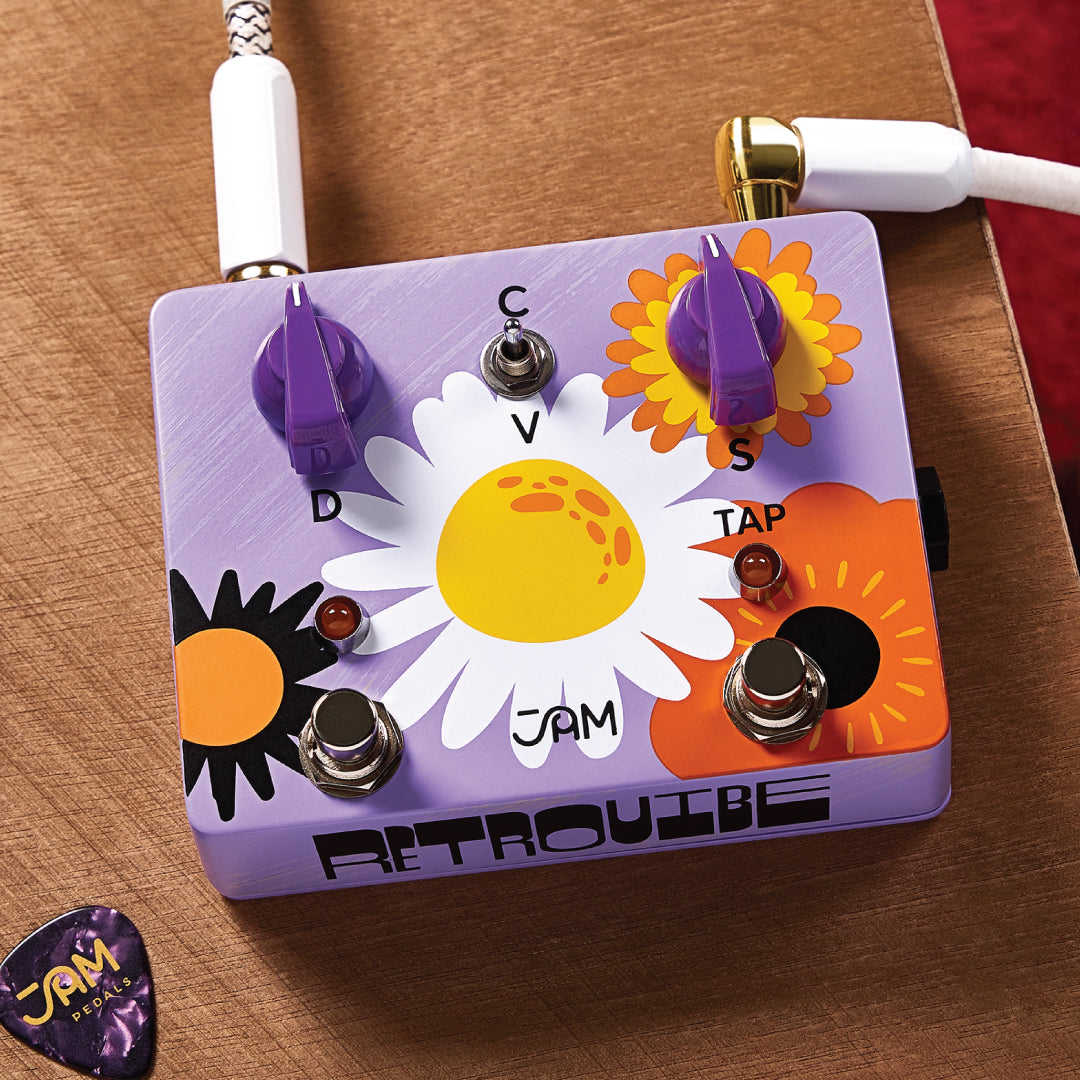
The JAM Pedals RetroVibe mk.4 is the option to consider when you want an all-analog vibe with more control during a song. It combines Chorus and Vibrato modes with tap tempo, a second ramping speed, and expression control.
Pros
- All-analog Chorus and Vibrato modes
- Tap tempo, speed ramping, and expression control
Cons
- Output level can only be adjusted with an internal trimmer
The TAP/RAMP footswitch lets you tap in a rate or hold the switch to move toward another speed. You can set the destination rate and travel time, making it useful for a passage that gradually becomes faster instead of changing abruptly at a section boundary.
A passive 10kΩ expression pedal can provide continuous Speed control, and a separate input accepts an external tap switch. Those are practical performance features if the effect is a regular part of your set. For a fixed slow pulse used in one song, they may be more than you need.
Make sure the listing is for mk.4. Older RetroVibe editions have different control arrangements, and an image of a previous model should not be taken as evidence that tap and ramp functions are included. Choose mk.4 for expressive onstage rate changes; choose a simpler pedal if you intend to set one speed and leave it there.

5. Electro-Harmonix Good Vibes
Electro-Harmonix Good Vibes is worth considering if you want to choose whether an expression pedal changes the speed or the depth of the effect. Its photocell-based modulation has Chorus and Vibrato modes, with Volume, Intensity, and Speed controls on the main panel.
Pros
- Photocell-based Chorus and Vibrato
- Expression can control speed or intensity
Cons
- Mono only; no stereo output
The expression assignment is useful when a song needs the same basic pulse but a stronger effect during a sustained passage. Assigning Intensity gives you that change without speeding up the sweep. Assigning Speed produces the more familiar slow-to-fast movement.
An always-on speed indicator helps show the current rate before you engage the effect. Set the output level against bypass first, then use the expression pedal across its full travel to make sure the available range is practical. An extreme setting can be interesting alone but difficult to place behind a singer.
Choose Good Vibes for this relatively focused set of hands-free controls. It is a mono pedal without MIDI preset recall. Use the manufacturer’s specified power adapter arrangement and check expression compatibility; do not assume any spare control pedal will give the intended sweep without adjustment.
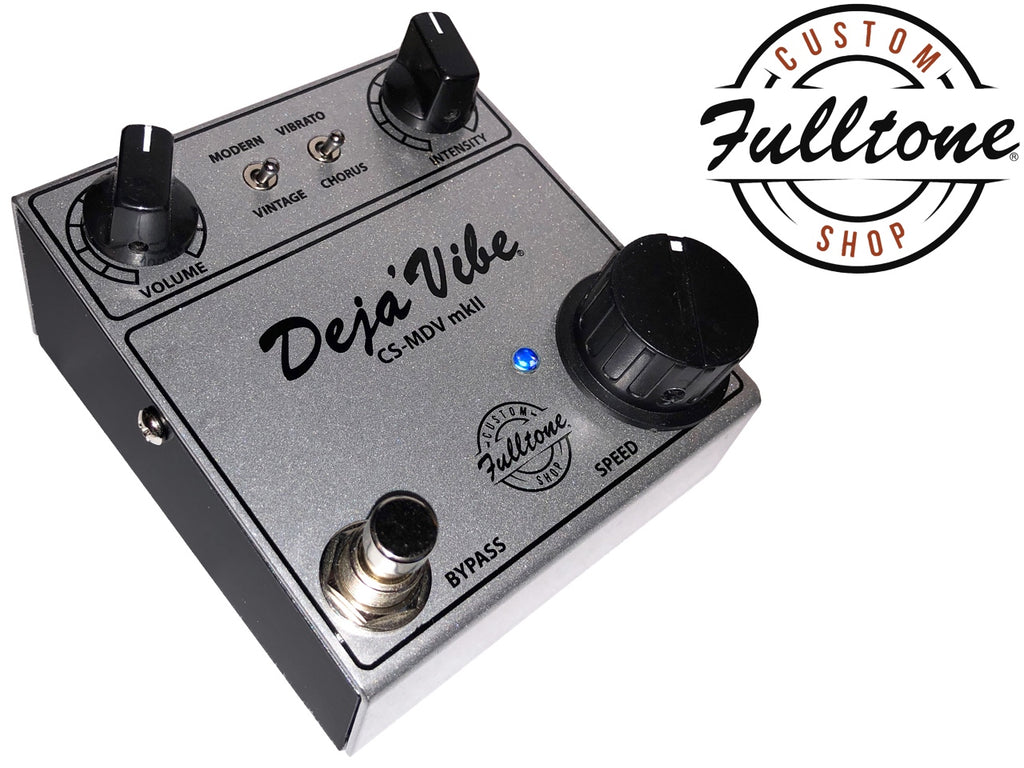
6. Fulltone Custom Shop Mini DejáVibe mkII
The Fulltone Custom Shop Mini DejáVibe mkII is the focused choice for players who want an analog audio path with an incandescent bulb and photocells. Its external expression connection allows you to change the rate without bending down during a performance.
Pros
- Incandescent bulb and photocell construction
- External expression connection for rate changes
Cons
- Requires an 18V power supply
The smaller enclosure and top-mounted jacks help fit it into a crowded board. Fulltone’s revised rate control is intended to give a more usable progression across slow and fast settings. Try that range with your playing, because a useful slow swirl and an exaggerated fast wobble serve different musical parts.
The output-level adjustment is useful when the effect changes the perceived strength of a guitar part. Set a repeatable bypass comparison before adding more gain from an overdrive or amplifier. Increasing level into a driven amp can change distortion as well as loudness.
Check the exact model and power requirements. The CS-MDV mkII is different from the treadle-style Mini DejáVibe 3, and the official package specifies an 18V power supply. Choose it for its optical circuit and expression workflow, not on the assumption that all Fulltone models accept the same power or have the same enclosure.
How to Choose a Uni-Vibe Pedal
Chorus and Vibrato Modes
On a traditional vibe, Chorus combines the modulated signal with the dry guitar to produce the familiar phase-like pulse. Vibrato gives you the modulated signal by itself, making pitch movement more apparent. These labels describe the vibe’s operating modes; they do not mean it is identical to an ordinary chorus pedal.
Try both with sustained chords and single-note lines. A setting that works behind an instrumental solo can compete with a vocal, so check the effect level and depth in the arrangement.
Optical Circuit or Digital Modeling?
A traditional optical vibe uses a light source and light-dependent components within its modulation circuit. DryBell, Fulltone, and EHX explicitly describe optical construction, while UltraViolet models an optical system digitally. Architecture matters if a particular circuit is part of what you want to buy, but it does not decide which controls fit your performance.
Compare the response with the guitar, drive, and amplifier you use. Do not infer internal parts from a product name alone, or assume every analog modulation pedal follows the same design.
Will You Change Speed While Playing?
A speed knob is enough if you use one slow pulse throughout a song. Expression control is useful when you want gradual changes, while tap tempo makes it easier to set a rhythmic rate onstage. Ramping gives you a repeatable transition between speeds without moving an expression treadle.
Check what requires an additional controller. A pedal with an expression jack does not necessarily include an expression pedal, and one shared control socket may not accept every accessory at once.
Placement and Power
A useful starting point is vibe before an overdrive or driven amp. This lets the modulation feed the distorted sound. Moving it after drive can make the movement more pronounced, so try both before deciding that the pedal is wrong for your rig. Fuzz interactions can also depend on impedance and placement.
Follow the exact model’s power instructions. The pedals here do not all require the same supply voltage or current. Top-mounted jacks, switch spacing, and room for an expression lead also matter on a board that already has closely packed pedals.
Frequently Asked Questions
Is a Uni-Vibe the Same as a Phaser?
They share a phase-related sweeping character, but a traditional vibe uses a particular optical circuit and unevenly placed phase stages that give it a distinctive pulse. A standard phaser can provide related movement without being a direct substitute. Choose according to the sound and control you need.
Do I Need an Expression Pedal?
Only if you want continuous hands-free changes and the selected vibe supports it. The M68 works entirely from its panel controls. DryBell, RetroVibe mk.4, Good Vibes, Fulltone, and UltraViolet provide different external-control options, so check the supported controller and assignment before buying an accessory.
Can a Uni-Vibe Pedal Work with a Clean Amp?
Yes. A clean amplifier makes it easy to hear the movement itself. Adding overdrive afterward produces a different interaction, but a loud cranked amplifier is not a requirement for using the effect. Begin with a moderate depth so the original chord still has definition.
Which Uni-Vibe Pedal Is Easiest to Use?
The MXR M68 keeps the main choices to Level, Speed, Depth, and a mode switch. It makes sense for a player who wants a straightforward effect. Choose a more elaborate model when you can identify the additional function you need, such as MIDI recall, speed ramping, or detailed optical-circuit adjustment.
Summary
Choose Vibe Machine V-3 for a compact optical design with rig adjustments, M68 for simplicity, or UltraViolet for stereo and MIDI. RetroVibe mk.4 adds tap and ramp performance tools, Good Vibes lets expression control speed or intensity, and Fulltone offers a traditional optical route with external rate control. Match the control method to the way you actually play.