Guitar harmonizer pedals add intervals, scale-aware harmonies, or sweeping pitch changes. For backing voices added to singing, see our vocal harmonizer guide.
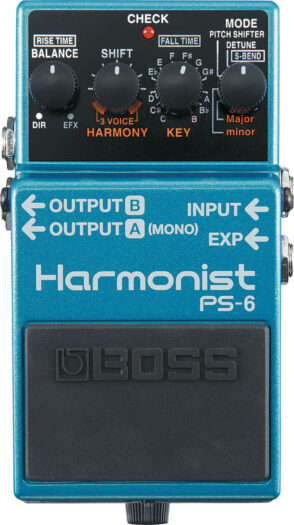
My top recommendation is the Boss PS-6 Harmonist for compact lead harmonies, with major/minor key selection and additional Pitch Shifter, Detune, and S-BEND modes.
My budget recommendation is the TC Electronic Quintessence Harmony for selectable keys and scales, TonePrint editing, and pressure-controlled expression through its MASH footswitch.
Contents
- The Best Harmonizer Pedals for Guitar (2026)
- 1. Boss PS-6 Harmonist
- 2. TC Electronic Quintessence Harmony
- 3. Electro-Harmonix Intelligent Harmony Machine
- 4. Eventide H90 Harmonizer
- 5. Electro-Harmonix Pitch Fork +
- 6. DigiTech Whammy 5
- Intelligent Harmony or Fixed Pitch Shifting?
- Can a Harmonizer Handle Chords?
- Where Should the Harmonizer Go on a Pedalboard?
- What Matters for Live Use?
- Verdict
The Best Harmonizer Pedals for Guitar (2026)

Diatonic leads plus fixed-interval chord shifting
1. Boss PS-6 Harmonist
The Boss PS-6 Harmonist is my first pick for a guitarist who wants keyed lead harmonies in a compact pedal. Harmony mode lets you choose a major or minor key and a voicing, adding notes above or below your played line without building a larger multi-effects setup.
Pros
- Major/minor keyed harmony with two- and three-voice options
- Pitch Shifter, Detune, and S-BEND modes
Cons
- No onboard presets for switching between songs
The pedal also includes Pitch Shifter, Detune, and S-BEND modes. That gives it uses beyond harmonized solos, such as thickening a part or adding a pitch sweep. Its two- and three-voice options include the original signal, so a three-voice sound should not be mistaken for three additional guitar parts.
The controls are fairly direct, but setting the right key is still part of using the effect. A harmonized third needs to change size within a scale, and choosing the wrong key can create notes that clash with the backing chords. Practice the actual phrase with the band or a backing track before relying on it live.
Choose the PS-6 for a focused stompbox role with several useful pitch effects. It does not give you a bank of song presets to step through like a larger processor. If every song needs a different prepared program and MIDI control, the H90 is the more appropriate comparison.

2. TC Electronic Quintessence Harmony
TC Electronic’s Quintessence Harmony is the compact option for a player who wants to choose a key and scale, then add expression from the footswitch itself. Its MASH switch responds to pressure, letting you change the harmony behavior while keeping the pedal’s footprint small.
Pros
- Direct Key, Scale, Harmony, and Mix controls
- Pressure-sensitive MASH switch and TonePrint support
Cons
- No input for a separate expression pedal
The pedal uses separate Key, Scale, Harmony, and Mix controls. That gives you more direct scale selection than a pedal limited to a simple major/minor choice. TonePrint support also provides a route to different programmed behaviors, which is useful if a stock interval combination does not fit the musical part you have in mind.
MASH needs practice if you want a repeatable result during a performance. Treat it as an expressive control rather than expecting every press to behave like a conventional on/off switch. Try the phrase standing up, with the shoes and pedalboard position you expect to use.
Choose Quintessence when its scale options and pressure control are the attraction. A regular expression treadle gives a different kind of foot movement, so the Whammy is the more direct comparison if wide pedal sweeps are central to your playing. For simple keyed lead lines, compare Quintessence with the PS-6 on ease of operation.
3. Electro-Harmonix Intelligent Harmony Machine
The Electro-Harmonix Intelligent Harmony Machine is a good choice if you want a compact pedal that separates keyed single-note harmony from polyphonic pitch shifting. Its Intelligent mode generates diatonic harmony from the notes you play after you set the key and major or minor tonality.
Pros
- Intelligent mode for diatonic single-note harmony
- Separate Polyphonic Override for fixed-interval shifting
Cons
- Key-aware harmonies work with single-note lines, not chords
The interval selector includes two- and three-part choices, with Mix and Volume controls for fitting the result around the original guitar. Polyphonic Override changes the job: it lets you shift single notes or chords by the selected interval instead of generating a scale-aware harmony from a single-note melody.
That distinction is worth understanding before buying. The word polyphonic does not mean the pedal will automatically arrange every note of a complex chord into a musically appropriate harmony. Use Intelligent mode for the lead lines it is designed to follow and Override for the fixed-interval effect.
Momentary operation is useful for adding an effect to a short passage without leaving it on for a whole section. Choose the full Intelligent Harmony Machine specifically if these controls and the Override workflow matter; the smaller Pico version has a different control arrangement and should be compared as a separate product.

4. Eventide H90 Harmonizer
The Eventide H90 is the choice for a guitarist who wants harmony as part of a deeper effects system. It can run two algorithms in a program, giving you ways to combine pitch processing with delay, modulation, or another effect instead of adding several separate stompboxes.
Pros
- Two algorithms can run within one program
- Program recall, MIDI, expression, and flexible routing
Cons
- Programming takes more work than a simple harmony pedal
Its pitch collection includes scale-based harmonization and polyphonic pitch effects, but their behavior depends on the selected algorithm. You need to choose and configure the appropriate effect for a single-note harmonized line, chord shifting, or more unusual pitch movement. The H90 label does not make every algorithm do the same job.
Program recall, MIDI, expression control, and flexible routing are the reasons to shortlist it for a prepared live rig. You can build sounds for particular songs and practice recalling them, rather than reaching down to reset several knobs between sections. That workflow is especially useful when harmonies are only one part of your effects requirements.
The tradeoff is complexity. If you want one harmonized lead sound and little else, a PS-6 or Intelligent Harmony Machine is easier to approach. Choose the H90 when you will use its routing and program system, and leave time to learn the controls before placing it at the center of a performance setup.

5. Electro-Harmonix Pitch Fork +
The Electro-Harmonix Pitch Fork + is the option for players who want to design fixed-interval pitch layers. Its two pitch engines have separate level controls, alongside a control for the dry signal, so you can blend both shifted voices without treating them as one combined effect.
Pros
- Two pitch engines with independent level controls
- Preset storage and Main/Aux output routing
Cons
- Won’t automatically keep harmonies in a chosen key
Each engine can shift up or down through a three-octave range, with detuning also available. The pedal has preset storage, expression control, and Main and Aux output routing. That makes it useful for deliberate pitch textures and prepared combinations, including sounds built from octaves, fifths, or other fixed intervals.
The limitation is central to the purchase: it is not a key-aware diatonic lead harmonizer. A fixed major third remains a major third as you change notes, which will not stay inside every major-scale melody. If you want automatically changing thirds or sixths within a chosen key, start with the keyed options above.
Choose Pitch Fork + when independent voices and control over the pitch layer matter more than automatic scale correction. The extra menus and programmable controls are worthwhile for someone building sounds, but can be unnecessary if all you want is one octave or a single straightforward harmony setting.

6. DigiTech Whammy 5
The DigiTech Whammy 5 is the performance choice when you want to move pitch with a full-size treadle. Its Harmony settings blend a shifted voice with the original signal, while the pedal moves the harmony between the intervals selected on the control panel.
Pros
- Full-size treadle for pitch movement
- Harmony mode blends shifted and original signals
Cons
- Full-size treadle takes up substantial pedalboard space
This is a different idea from setting a key and letting the pedal arrange a lead line. The Whammy gives you direct control over a pitch movement, which is useful for bends, transitions, and deliberately exaggerated effects. Classic and Chords modes provide different tracking approaches for the material you play.
The treadle is its main advantage and its main space requirement. Check that you can place it where your foot has enough room to move, especially on a small board. A compact expression jack is not the same as having the expression pedal included in the effect’s chassis.
Choose the Whammy for the physical performance gesture. Choose the PS-6, Quintessence, or Intelligent Harmony Machine if the main requirement is an in-key harmony following a melody. Also distinguish Whammy 5 from Whammy DT and other Whammy-family products when comparing power requirements, features, and pedalboard space.
Intelligent Harmony or Fixed Pitch Shifting?
An intelligent harmonizer uses a selected key or scale to choose appropriate interval sizes for a played melody. In C major, a third above C is E, while a third above D is F. Those steps contain different numbers of semitones. A scale-aware pedal can make that change as the melody moves, provided the selected key and mode fit the music.
A fixed pitch shifter moves the signal by the same number of semitones. It is useful for octaves, fixed fifths, parallel effects, and unusual chord layers. A fixed major third above D would be F sharp, which differs from the F in the C-major example. That is a musical difference, not a fault with the pedal.
A song can also use notes outside its main key or change key entirely. A setting that works for most of a solo may clash over one chord. Practice the complete part and decide whether to change a setting, recall another preset, or switch the effect off for that phrase.
Can a Harmonizer Handle Chords?
Polyphonic pitch shifting can process more than one input note, but check what the particular mode does. Fixed-interval shifting of a whole chord is different from generating a new diatonic arrangement for every voice inside it. The Intelligent Harmony Machine explicitly separates its single-note Intelligent mode from Polyphonic Override.
For tight harmonized lead playing, clean muting helps the processor follow the note you intend. Open strings ringing underneath a phrase, excessive distortion before the pedal, or heavy modulation can complicate the input. Test the pedal with the exact guitar and signal chain you plan to use rather than assuming a perfect result on every source.
Where Should the Harmonizer Go on a Pedalboard?
A useful starting point is early in the chain, before heavy distortion, delay, and reverb, so it receives a clearer guitar signal. Then listen to the result. Pitch shifting before distortion lets the original and shifted notes drive the gain stage together, while placing it later can produce a different separation and texture.
There is no reason to copy a diagram blindly if the pedal’s manual or your intended effect calls for another arrangement. Compare both positions at a manageable volume and listen to the attack, note clarity, and noise. Our guitar EQ pedal guide covers another way to shape the signal around your effects.
What Matters for Live Use?
Decide how many sounds you actually need during a set. A compact pedal with one working setting can be ideal for a recurring harmony phrase. If several songs require different keys, scales, and mixes, preset recall and MIDI can become more useful than another interval option.
Check the power supply, polarity, and current requirement of the exact model. Digital pitch effects can have different requirements from simple analog pedals. Also allow room for expression pedals and cables rather than measuring only the effect enclosure. A treadle needs enough clearance to move comfortably.
Keep the harmony lower in the mix at first. A shifted voice that sounds impressive alone can distract from the melody or conflict with the keyboard part in a band. Rehearse the balance at performance volume and decide where the added part should appear, rather than leaving it active through every section.
Verdict
Choose the PS-6 for a compact keyed harmony pedal, or compare the Intelligent Harmony Machine and Quintessence for their particular control options. The H90 suits a larger programmed rig. Pitch Fork + and Whammy 5 are the deliberate fixed-interval and pitch-performance alternatives; they should not be bought with the expectation that they will automatically keep every melody in a chosen key.