The 6 Best Bass Octave Pedals of 2026

A bass octave pedal can add weight to a clean line or turn a simple riff into a layered part. These six choices compare analog octave-down sounds, polyphonic tracking, dry blends, and pedalboard space.
My top pick is the MXR Bass Octave Deluxe M288 for its two differently voiced analog octave-down sounds, dry blend, and Mid+ control.
My budget pick is the MXR Vintage Bass Octave M280, which fits separate one- and two-octave-down voices into a smaller, lower-cost enclosure.
Contents
The Best Bass Octave Pedals (2026)
1. MXR Bass Octave Deluxe M288
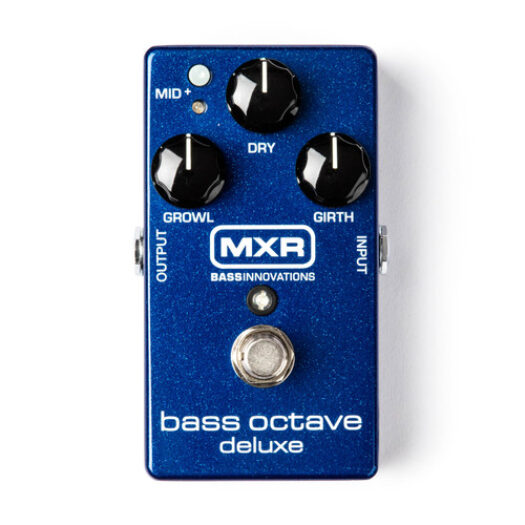
The MXR Bass Octave Deluxe M288 is my first pick for a bassist who mainly wants a strong octave-down sound with useful tone control. Its two analog voices, Growl and Girth, let you balance a more pronounced character against a deeper supporting voice.
Pros
- Two differently voiced analog octave-down sounds
- Dry blend and Mid+ control
Cons
- No upper octave or polyphonic chord processing
Both voices sit one octave below the played note. They are different tones, not separate one-octave and two-octave outputs. A Dry control brings back the original bass, which helps preserve the attack and lets you add weight without making the whole line indistinct.
The Mid+ switch boosts the clean signal’s midrange, with internal adjustment available. That is useful when the octave sounds large alone but disappears behind drums and guitars. Set the dry bass clearly first, then introduce the octave voices until the extra layer supports the part.
Choose the M288 for single-note lines and a hands-on analog blend. It does not give you an octave above, and it is not the option here for chord processing. Although its internal circuitry increases headroom, the specified external supply is 9V; do not confuse an internal voltage conversion with permission to use a different adapter.

2. MXR Vintage Bass Octave M280
The MXR Vintage Bass Octave M280 is the small-board alternative when you want separate one-octave-down and two-octave-down voices. Its mini enclosure saves space, while Oct 1, Oct 2, and Dry controls keep the main blend accessible.
Pros
- Separate one- and two-octave-down voices
- Mini enclosure with dry-signal mid boost
Cons
- No battery option; an external 9V supply is required
This differs from the M288: the Deluxe has two differently voiced sounds at the same lower octave, while the M280 gives you two different pitch intervals. That makes the Vintage model interesting for high-register parts that need a much deeper layer underneath.
The Mid switch adds definition to the dry signal, with further adjustment inside the pedal. Keep the second lower octave restrained when the line moves down the neck, because a very low generated fundamental can demand more from the amplification without helping the note speak clearly.
Choose the M280 for its small footprint and two lower octaves. The controls are closer together than on a larger pedal, and power comes from an external 9V supply rather than a battery. As with the M288, internal headroom circuitry does not change the adapter voltage you should connect.

3. Boss OC-5
The Boss OC-5 is the broader recommendation when you want to compare traditional octave-bass sounds with polyphonic processing. Vintage mode follows the mono OC-2 approach, while Poly mode handles chords and offers a Range control for choosing which notes receive the lower octave.
Pros
- Vintage and Poly modes with octave-up options
- Range control and separate Direct Out
Cons
- No tone control for shaping the octave sound
The Bass/Guitar switch optimizes the tracking engine for the instrument. Use the Bass setting as your starting point and set the direct and octave levels with the full band playing. Vintage mode gives you independent levels for one and two octaves below, and an octave-up voice is also available.
In Poly mode, the lowest Range setting can apply the lower octave only to the bottom note of a chord. That is a useful feature for players who move between bass and guitar, although a bassist playing single-note lines may have less need for it. The Direct Out also supports separate dry and effect routing.
Choose the OC-5 when that flexibility matters more than having two different analog octave-down tone controls. Do not assume every mode handles the same material identically. Try your normal fingering and note range, particularly if you want to combine octaves with double-stops.

4. Aguilar Octamizer
The Aguilar Octamizer suits bassists who want to shape the original sound as carefully as the generated octave. Its all-analog design has independent Clean and Octave levels, with a separate tone control for each path.
Pros
- Separate clean and octave tone controls
- Independent level controls for both paths
Cons
- A separate 9V power supply is required
Clean Tone is a tilt EQ: moving it changes the balance between bass and treble. The octave path uses a variable low-pass filter. These controls let you retain definition in the clean bass while deciding whether the octave should be a subdued foundation or a more obvious synth-like voice.
That distinction is useful for fingerstyle grooves where the original note needs to remain audible. Begin with a comfortable clean level, turn down the octave’s brighter harmonics, and add more octave only as the arrangement allows. A sparse trio can leave room for a heavier blend than a dense keyboard-led band.
Choose the Octamizer for this focused one-octave-down sound. It does not add an upper octave or polyphonic chord modes. The current version uses a 9V external supply, which is not included, so check the package rather than relying on the battery arrangements of older versions.
5. Electro-Harmonix Nano POG
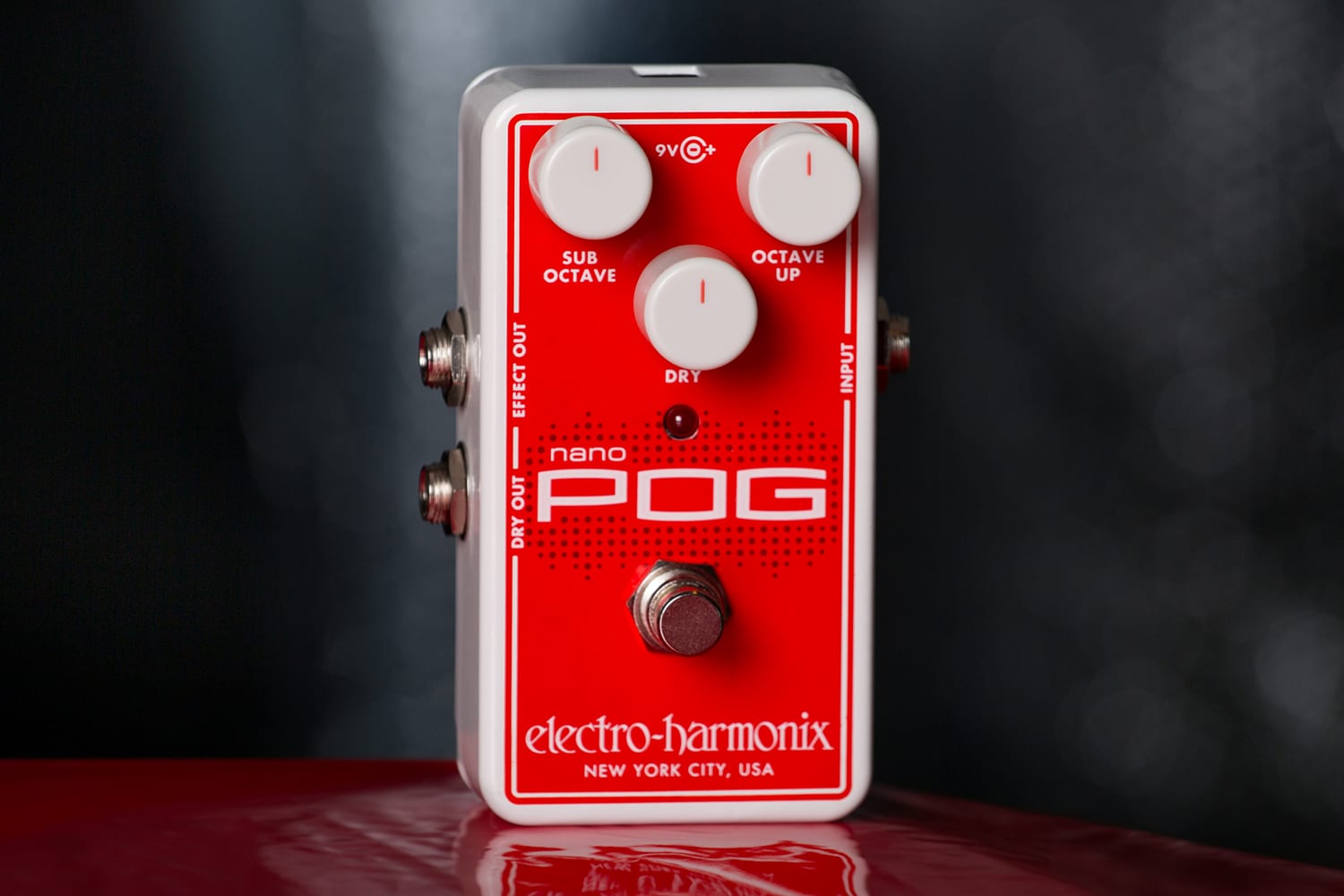
The Electro-Harmonix Nano POG is the choice here for a bassist who wants an upper octave as well as a lower one. Its digital polyphonic processing is designed for single notes, arpeggios, and chords, with three level controls for the original, sub-octave, and octave-up signals.
Pros
- Polyphonic octave-up and octave-down layering
- Separate Dry Out for another signal path
Cons
- No presets for recalling different octave blends
An upper octave can make a bass melody more audible without adding another instrument. Combined with the lower voice, it can also move a simple line toward an organ-like texture. Keep the original note present if the bass still needs to define the groove clearly.
The extra Dry Out gives you a separate original signal for a second path. You could record dry and processed sounds on different interface inputs, then decide how much effect belongs in the final mix. It is a routing option, not a substitute for level matching between channels.
Choose Nano POG for straightforward polyphonic octave layering. It has no elaborate filter or preset system, and its character differs from the analog octave-down pedals above. If the main goal is an adjustable dark sub voice, compare the Octamizer or M288 before paying for polyphonic features you may not use.

6. EBS OctaBass Blue Label
The EBS OctaBass Blue Label is worth considering if your octave parts move between different areas of the fretboard. Its Range switch shifts the tracking circuit’s optimized focus higher or lower, giving you a control related to how you play rather than only to the effect’s tone.
Pros
- Range switch adjusts the tracking focus
- Separate dry, octave and tone controls
Cons
- One octave below only; no chord-processing mode
Normal and Octave controls set the original and generated levels, while Tone moves the octave from a more present voice toward a deeper supporting sound. It remains an analog octave divider generating a note one octave below the source.
Choose the tracking range using the passage you actually need to perform. Then adjust Tone and blend at rehearsal volume. A setting that supports a high-register fill may need a different balance when the song returns to low root notes, so avoid judging the pedal using only one sustained test note.
Make sure you are buying the Blue Label version. EBS has produced several OctaBass editions, and the function of an older model’s switch should not be assumed to match this one. Choose Nano POG or OC-5 if chord processing and an octave-up voice are part of your requirements.
What to Look for in a Bass Octave Pedal
Monophonic or Polyphonic?
Monophonic octave pedals are intended to follow one note at a time. Clean fretting and muting help the circuit identify that note. Polyphonic processing is designed for more than one simultaneous note, making it more appropriate for double-stops and chords. It still makes sense to try the pedal with your own playing rather than treating polyphonic as a guarantee of identical results on every bass.
Choose an analog divider for the single-note character you enjoy, or a polyphonic pedal for the musical parts that require it. A feature you never use is not a reason to ignore a simpler pedal with a more suitable blend.
How Low Do You Need to Go?
An octave below a low bass note can fall beneath the range that a small speaker reproduces strongly. You may hear more of its upper harmonics than its fundamental. Try the effect higher on the neck before concluding that you need more level or a second lower octave.
Judge the sound through the rig used for the performance. Headphones, a practice combo, and a PA with subwoofers can give different impressions of the same pedal. Keep the dry note audible so the line has definition as well as weight.
Blend and Tracking
A dry-level control lets you retain the original attack. Tone or filter controls shape how obviously the octave stands apart from it. Start with the effect quieter than the dry bass, then raise it until the change is useful in the arrangement.
For a reliable starting point, place the octave before heavy fuzz or other effects that make the input harder to identify. EBS specifically recommends a clean input to OctaBass. Muting unused strings and playing clear single notes can improve the result before you change the equipment.
Power and Pedalboard Practicalities
Check the specified supply voltage, polarity, and current draw for the exact version. A pedal that creates a higher voltage internally may still require a 9V adapter. Use the manufacturer’s power instructions rather than assuming a related model accepts the same supply.
Also consider access to switches and knobs. A compact pedal saves room, but a small switch can be awkward between closely packed units. If the pedal has a separate dry output, plan where that signal is going before adding another cable to the board.
Frequently Asked Questions
Where Should a Bass Octave Pedal Go in the Chain?
Start early in the chain with a clean, clearly defined input, then put heavy drive or filtering afterward. That gives a monophonic divider a simpler signal to follow. You can experiment with other orders for a deliberate effect, but establish a reliable basic sound first.
Will an Octave Pedal Work with a Five-String Bass?
It can, but test the actual passages and low notes you intend to use. An octave-down effect on the lowest strings may produce energy that the speaker cannot reproduce clearly. A higher-position line often gives a more useful audible octave than adding extreme low end to the lowest open note.
Is an Octave Pedal the Same as an Octave Fuzz?
No. A dedicated octave pedal focuses on pitch generation and blending. An octave fuzz also produces distortion, and its upper-octave character behaves differently from a clean polyphonic octave-up signal. Buy for the sound and playing method you need rather than treating the names as interchangeable.
Which Bass Octave Pedal Is Best for Beginners?
The M288 gives you a focused analog octave-down blend with two tone characters. The OC-5 is the better starting point if you are still deciding between vintage mono sounds, polyphonic playing, and octave-up effects. Both benefit from learning how the dry level works with the generated sound.
Summary
Choose the M288 for adjustable analog octave-down tone, OC-5 for flexibility, or Nano POG for simple polyphonic layering. Octamizer adds independent tone shaping, OctaBass Blue Label lets you adjust tracking focus, and M280 fits two lower octaves onto a compact board. Try the pedal with the note range and amplification you will actually use.