The 10 Best Subwoofers For Music And Movies (2026)

Do you know what really makes for an incredible music-listening or movie-watching experience? When all the notes across different frequency ranges hit just right. And while a good pair of speakers may capture the highs and the mids, it’s the subwoofer that brings out the low end in all its glory.
If you are on the lookout for the perfect subwoofer, you’ve come to the right place. Today, I’ll take you through my top 10 subwoofers that will give new life to speakers and take your music and movie experience to the next level.
My main recommended product is the SVS SB-1000 Pro. This is one of the best subwoofers available today with premium quality sound.
My second recommended product is the Rockville Rock Shaker 10. This is a great subwoofer to consider if you’re running on a tight budget.
Contents
- The Best Subwoofers For Music And Movies (2026)
- 1. SVS SB-1000 Pro
- 2. Rockville Rock Shaker 10
- 3. SVS SB-2000 Pro
- 4. Klipsch Reference R-101SW
- 5. Definitive Technology Descend DN10
- 6. Sony SA-CS9M2
- 7. Sonos Sub 4
- 8. Polk Monitor XT12
- 9. Yamaha NS-SW100BL
- 10. Bic Acoustech PL-200 II
- Is a Subwoofer worth it?
- What’s the difference between a Woofer and a Subwoofer?
- Where do I position my Subwoofer for my Home Theater?
- What to look for in a Subwoofer for music and movies when buying?
- Verdict
The Best Subwoofers For Music And Movies (2026)

And now onto the full list:

Known for its high-end audio products, SVS is a premium brand with some incredible subwoofers. One of them is the SB-1000 Pro, which I feel, is the best you can get, no matter the application.
Pros
- Natural, yet powerful low ends
- Handles high output levels well
- Wireless controls
Cons
- Better options available for larger rooms
- No app-based automatic room correction
Being a 12-inch subwoofer, the SB-1000 Pro is ideal for a small to medium-sized room. The 12-inch front-firing high excursion SVS driver along with the super-powerful 325 watts RMS, 820+ watts peak power Sledge amplifier, and MOSFET output tends to take the room by storm with its accurate, yet thudding bass sound system.
It’s crystal clear in capturing frequencies as low as 20 Hz. The low-ends on this thing are as natural as they get. Add to this its high max SPL handling, and you’re bound to get great bass without distortion, unless you crank up the volume too high, of course.
| Power output | 325 watts RMS (820+W Peak Dynamic) |
| Driver size | 12” |
| Frequency response | 20-270 Hz |
| Inputs | RCA, Speaker Level, 12 V Trigger |
| Bonus features | Bluetooth-enabled |
The SB-1000 Pro is controlled via Bluetooth and is compatible with iOS and Android. All you need to do is download the SVS Subwoofer DSP app, and you can control and customize the subwoofer’s settings as you please.

You don’t always have to spend a lot of money to have an exciting bass experience. Sometimes, you’re simply looking for a product to satisfy your needs on a budget. If this is the case, then this Rockville Rock Shaker 10-inch subwoofer should be a good choice for you.
Pros
- Affordable option
- Sounds nice for the price
- Gains can be set using knob controls
Cons
- Build quality isn’t quite as good as the higher-end options here, but it’s not too bad for it’s price.
It’s a plain-looking subwoofer but does a great job of producing smooth low ends. On the outside, it sports an MDF wood body, giving it a nice, warm sound. On the inside, there is a Class D amplifier that ties the whole thing together. While it doesn’t have much going for it in terms of design, it’s well worth the money you spend as far as its sound is concerned.
It has a frequency range of 20 – 200 Hz. And with a standard 300 watts RMS and 600 watts peak power, it’s swell at handling higher volumes. So, you get a clear bass sound without too much distortion. Its rear controls cover the essentials, but there is no app-based EQ for adjusting room-related bass peaks.
| Power output | 300 watts RMS / 600 watts peak |
| Driver size | 10” |
| Frequency response | 20 – 200 Hz |
| Inputs | RCA line, Speaker high-level |
| Bonus features | None |
Being an entry-level subwoofer, of course, you’re not going to get your head blown off by this thing. But even with a small driver size, it is worth looking at. Add to that the wide compatibility and accessible control knobs, and it becomes the best budget subwoofer pick.

Another SVS subwoofer on the list, the SB-2000 Pro is a step higher, or lower I should say, than the SB-1000 Pro. In some ways, it shares a lot of features with its predecessor. However, SB-2000 Pro is significantly more powerful.
Pros
- Captures super low frequencies
- Supports Bluetooth
- High max SPL
Cons
- A bit pricey
While it also features a 12-inch high-excursion SVS driver, much like its smaller sibling, its RMS wattage sits at 550 watts with an incredible peak of 1500+ watts. Handling distortion at high volumes is no problem.
The factory frequency response for the SB-2000 Pro is 19 – 240 Hz. Although, it can go as low as 17 Hz. So, you’re going to hear bass notes you didn’t even know existed, with brilliant clarity. All this, along with the sealed cabinet, makes for a great overall subwoofer.
| Power output | 550 watts RMS (1500+W Peak Dynamic) |
| Driver size | 12” |
| Frequency response | 19 – 240 Hz |
| Inputs | RCA, 12V trigger |
| Bonus features | Bluetooth-enabled |
This subwoofer is also Bluetooth-enabled. All you have to do is download the SVS subwoofer app. Sure, the price tag is aimed at the high-end segment. But if budget isn’t a problem for you, it’s a great subwoofer to own.
4. Klipsch Reference R-101SW
Klipsch has built a solid reputation for home audio, and the Reference R-101SW is a sensible choice if you want a straightforward subwoofer for both music and movies. Its 10-inch front-firing driver sits in a ported cabinet, so leave some space behind it for the rear port.
Pros
- 10-inch spun-copper TCP woofer
- Line/LFE inputs work with common AV receivers
- Adjustable crossover and phase
Cons
- Rear port needs clearance from the wall
The all-digital amplifier is rated at 150 watts continuous and 300 watts peak. That is enough to make it worth considering for a modest home theater, although amplifier wattage alone cannot tell you how loudly two different subwoofers will play.
The gain and low-pass controls let you blend it with your main speakers, while the phase switch helps with integration at your listening position. For an AV receiver that handles the crossover itself, use the LFE connection and follow the receiver’s setup procedure.
| Power output | 150 watts continuous / 300 watts peak |
| Driver size | 10 inches |
| Frequency response | 29.5-120 Hz, +/-3 dB |
| Inputs | Line/LFE RCA |
The R-101SW is a good fit for someone who wants useful receiver compatibility without app menus or wireless setup. It gives you a conventional wired subwoofer with accessible controls, rather than the room-EQ adjustments available on the SVS models.

5. Definitive Technology Descend DN10
If you don’t have a lot of space for a subwoofer or want a smaller one to be placed in a corner, then the Definitive Technology Descend DN10 is a solid choice. Despite its compact size, it delivers an impressively loud bass sound.
Pros
- Takes up little space
- Powerful, but natural bass
- No noise and distortion
Cons
- A bit pricey
Now, I know I have named it a compact subwoofer but the Definitive Technology Descend DN10 has a 10” driver. A lot of other subwoofers also have a 10” driver and may be smaller, but the performance makes a big difference. The DN10 is comparable to a lot of 12” subwoofers.
With a Class D digital amplification, it can handle a peak power of 500 watts while Descend’s patented 3XR architecture prevents noise pollution and distortion. The frequency response goes as low as 28 Hz, with a clear and natural low end.
| Power output | 200 watts RMS / 500 watts peak |
| Driver size | 10” |
| Frequency response | 28 – 200 Hz |
| Inputs | Single RCA, Speaker levels |
| Bonus features | 3XR architecture |
The back panel features volume and low pass control knobs, making it very easy for you to customize your sound. It also supports single RCA and speaker level inputs. Overall, this is a quality subwoofer to consider if you’re on the lookout for a compact product.
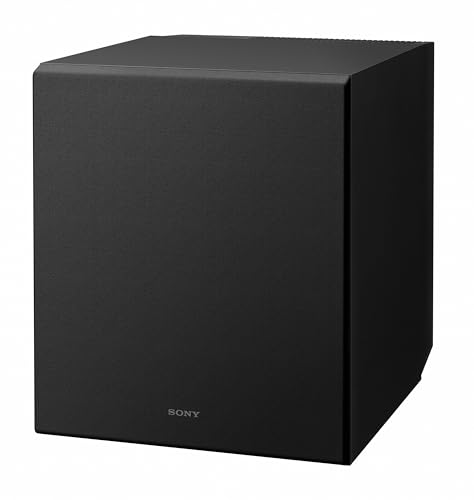
6. Sony SA-CS9M2
The Sony SA-CS9M2 is a compact, powered 10-inch subwoofer for a component home theater. It is the current model in Sony’s CS speaker range and keeps the simple controls that make this type of subwoofer approachable for a first setup.
Pros
- 10-inch driver in a bass-reflex enclosure
- Adjustable high-cut filter and phase
- Compact cabinet for a smaller system
Cons
- No app-based room EQ
Sony specifies a 28-200 Hz playback range and a practical maximum amplifier output of 125 watts. That maximum figure is not a continuous RMS rating, so it should not be compared directly with the continuous figures used by some other brands.
The high-cut control adjusts from 50 to 200 Hz. Use it to blend the subwoofer with your speakers, or follow your receiver’s bass-management instructions when connecting through its subwoofer output. The bass-reflex enclosure provides low-frequency reinforcement without needing a separate power amplifier.
| Power output | 125 watts practical maximum |
| Driver size | 10 inches |
| Playback bandwidth | 28-200 Hz |
| High-cut filter | 50-200 Hz |
I would consider this for a smaller home theater where easy setup and a compact cabinet matter more than extensive digital tuning. It can complement a compatible receiver and speakers; a Dolby Atmos label on the other speakers is not a requirement for using a subwoofer.

7. Sonos Sub 4
The Sonos Sub 4 is the wireless choice here for someone who already uses compatible Sonos speakers or a Sonos soundbar. Its two inward-facing, force-cancelling drivers add low bass while reducing cabinet vibration. It is a system-specific recommendation, so it is not a substitute for a conventional RCA subwoofer.
Pros
- Wireless connection to compatible Sonos systems
- Force-cancelling driver arrangement
- Can stand upright or lie flat
Cons
- Requires compatible Sonos speakers and the Sonos app
- Does not work with Playbar or Playbase
The Sub 4 reaches down to a stated 25 Hz and uses two Class D amplifiers. Sonos does not publish an amplifier wattage or driver diameter for this model, so those figures are not a useful basis for comparison with the wired subs in this list.
Setup and bass adjustment happen through the Sonos app over Wi-Fi. There is no RCA audio input, Ethernet port or microphone on Sub 4. Voice commands depend on a compatible voice-enabled speaker in your system; the subwoofer itself does not listen for commands.
| Amplification | Two Class D amplifiers; wattage not specified |
| Drivers | Two inward-facing force-cancelling drivers |
| Lower frequency limit | 25 Hz |
| Connection | Wi-Fi to compatible Sonos system |
The important buying decision is compatibility. Sub 4 works with supported Sonos products, including current Sonos home-theater speakers, but Sonos excludes Playbar and Playbase. Check your existing speaker model before choosing it. For a conventional stereo amplifier or AV receiver, choose one of the wired subwoofers instead.

8. Polk Monitor XT12
The Polk Monitor XT12 is a useful starting point if you want a 12-inch powered subwoofer for music and movies. It uses a front-firing driver in a bass-reflex cabinet, with controls that let you match the bass level and crossover to your existing speakers.
Pros
- 12-inch woofer for an accessible home-theater system
- RCA, LFE and speaker-level connections
- Adjustable crossover and phase
Cons
- Larger cabinet needs more floor space
Polk rates the Class A/B amplifier at 50 watts continuous and 100 watts peak. Those numbers are more modest than the peak ratings advertised for some rivals, but peak watts are not a reliable shortcut to sound quality or usable bass output.
The XT12’s connection options are a practical advantage. A dedicated LFE input suits an AV receiver, while line-level and speaker-level connections support other appropriate systems. The phase switch and adjustable low-pass filter help you blend its output with your main speakers.
| Power output | 50 watts continuous / 100 watts peak |
| Driver size | 12 inches |
| Frequency response | 24-160 Hz overall |
| Inputs | RCA line, LFE and speaker level |
This is a straightforward option for a first component system, especially when you want the flexibility to change amplifiers later. It does not offer the app-based tuning of the SVS models, but it covers the basic connections and adjustments that matter for a wired setup.

If you know music, you know Yamaha. The company has, year after year, produced high-quality music products from equipment to instruments. And the NS-SW100BL does the brand full justice.
Pros
- Sounds rich
- Looks great
- Great value for money
Cons
The subwoofer features a 10” driver for tight bass sounds. Capturing as low as 25 Hz, you can really hear a lot of intricacies. In just one listen, you’ll understand the hype behind this subwoofer.
At just 50 W, the amp output might be a little low for some. However, it handles distortions and noise like a boss. Its peak comes to 100 watts but, naturally, there could be some distortion if you push the sub too far.
| Power output | 50 watts RMS / 100 watts peak |
| Driver size | 10” |
| Frequency response | 25 – 180 Hz |
| Inputs | AV jack |
| Bonus features | None |
The sub makes a great addition to the room. Not only is it a compact subwoofer, but has a sleek, elegant design as well. So, if you don’t want to spend a fortune but still want a nice subwoofer, the Yamaha NS-SW100BL will serve your purpose.

10. Bic Acoustech PL-200 II
The Bic Acoustech PL-200 II is a dream subwoofer for an audiophile. In that, it produces excellent low ends and does not ask you to spend an absolute fortune. For a modest price, you get quality, first and foremost.
Pros
- Incredibly powerful subwoofer
- Solid construction
- Bang for buck
Cons
- Bulky design is not for everyone
- Not the best for small rooms
First of all, the Bic Acoustech PL-200 II is a powerhouse of a subwoofer. With a 12” driver, it can handle a peak power of 1000 watts. And it’s a very controlled, clear sound instead of flimsy vibrations.
It also has a frequency response that goes as low as 20 Hz. So, you’ll hear very deep bass notes clearly. Its wide port flares reduce noise while the box itself absorbs unwanted noise. It is a fairly bulky subwoofer but that just adds to the durability of the product.
| Power output | 250 watts RMS / 1000 watts peak |
| Driver size | 12″ |
| Frequency response | 20 – 200 Hz |
| Inputs | RCA / LFE |
| Bonus features | None |
The subwoofer is very well built with good durability. On the outside, it has a lacquer finish, giving it a nice, glossy finish and scratch-free properties.
Is a Subwoofer worth it?
Most pairs of speakers are just that – speakers. And the job of speakers is to produce the highs and the mids with a hint of bass. So, if you are keen on getting a better audio experience from your music or movies, it is well worth your while to add a subwoofer to your setup and turn it into a complete surround system.
A subwoofer does a great job of enriching audio by adding detailed bass when your general speakers can’t. Plus, you have very good, affordable options on the market that will enhance your experience while not breaking your bank.
What’s the difference between a Woofer and a Subwoofer?
While both are essentially loudspeakers that capture and produce low-frequency sounds, there are noticeable differences between the two. A woofer is much smaller than a subwoofer and is used when you want to hear frequencies above 30 or 40 Hz. A subwoofer is great for anything below the 30 Hz mark.
As far as the upper limit is concerned, a woofer responds to up to 2500 Hz, whereas a subwoofer reaches its limit at 240/250 Hz max. Because of this, a woofer is more often used in settings where you want to elevate your entire sound, including the lows and the highs. A subwoofer is only focused on the low ends.
Where do I position my Subwoofer for my Home Theater?
For those who are wondering about the placement, it can be a task to decide where to position their newly-bought subwoofer. At first thought, it might seem trivial, but optimal subwoofer placement can make or break the experience.
To get the best out of your subwoofer, try starting with placing it in the front. For a lot of speakers, this works as the whole stereo system feels in sync. Another place you can try is a corner. This way, the subwoofer, especially a powerful one, resonates its bass sound throughout the room.
But like all things subjective, you should experiment with subwoofer placements and decide what suits you best. If you need further help, you can check out a visual representation of where to place your subwoofer in our guide on multi-channel home theater systems.
Also, if you are planning to set up a home theater, you might want to get a power manager. Since a home theater has a lot of different devices that require decent power, there can be a lot of fluctuations in the electricity flow. A power manager regulates power, keeping your system safe.
What to look for in a Subwoofer for music and movies when buying?
You won’t be buying a subwoofer again and again. So, please make sure that you buy the right one for your needs. Let me share some of the things you should look out for.
The size of the driver is very important in the bass sound. A larger driver can move more air, but enclosure design, amplifier capability and room placement also affect the result. Driver size alone does not tell you which subwoofer sounds better. Another thing to keep in mind is its maximum output level. Subwoofers with higher watts of RMS power and peak power handle distortions at high volumes more smoothly.
Since subwoofers can be quite expensive, it’s on you to figure out how much you want to spend. If you want to add one to your home setup or are on a budget, you can go for the more entry-level ones. But if budget is not a problem or your studio requires a new subwoofer, it makes sense to buy a more premium subwoofer.
Lastly, look at setup and control features. The SVS models use Bluetooth for app control rather than music streaming, while Sonos requires a compatible Sonos system. Check the connections you need before choosing a wireless option.
Verdict
A good subwoofer can make your music and movie experience way more enjoyable. From low-end thumping bass sound to realistic movie explosions, a subwoofer is something to consider if you want a high-quality experience.
My top subwoofer pick is the SVS SB-1000 Pro. It’s great for all settings, has an intermediate price tag, but offers quality sound.
If you’re running on a budget, the Rockville Rock Shaker 10 is a nice option that will get the job done while sparing your pocket.