The 5 Best Text to Speech VST/AU Plugins (Free and Paid Options)
Text to speech plugins come in a few different forms. They all enable you to create synthetic voices on your computer from text. Some speak in a deliberately robotic voice; others sing lyrics to notes you enter or play.
Alter/Ego is a useful free starting point for playable singing voices, while VST Speek is better for short, crunchy spoken phrases. For detailed vocal arrangements, VOCALOID6 and Synthesizer V Studio 2 Pro give you a dedicated editor.
Contents
1. Alter/Ego (Free)

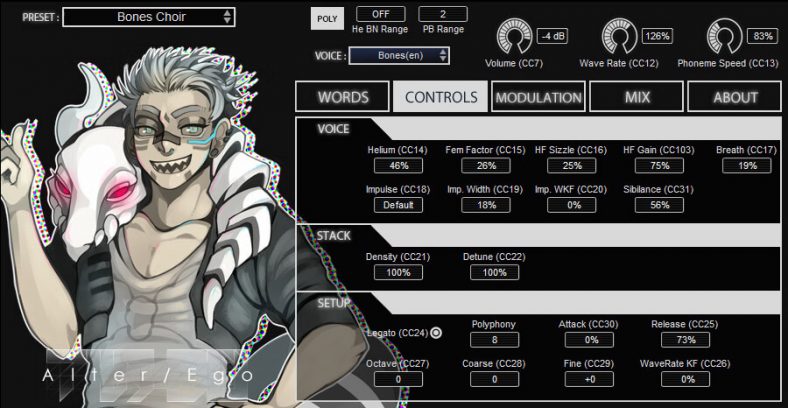
Alter/Ego shown with the ALYS voicebank. Voices are installed separately.
We start off this list with a free plugin from Plogue. Alter/Ego runs as a standalone application or in a compatible DAW, with VST, VST3 and AAX formats on Windows and macOS, plus AU on Mac.
It shares technology with chipspeech, but its focus is more modern singing synthesis rather than recreating early speech chips. Type in lyrics, then play the melody from a MIDI keyboard. The voice can be shaped like an instrument, which makes it useful for unusual backing parts and synthetic hooks.
Plogue lists Alter/Ego as a legacy product, though its free installer remains available. Install a voicebank separately: the downloads page provides routes for Bones and Marie Ork 2. Each bank has its own licence terms, so the free engine does not make every voicebank interchangeable or unrestricted.
The listed requirements are 64-bit Windows 10 or later or macOS 10.13 or later. This is a good option if you enjoy programming a voice, but expect to spend time learning how lyric timing and MIDI notes interact.
2. VST Speek (Free)

VST Speek is a free plugin based on S.A.M., the Software Automatic Mouth speech synthesizer associated with the Commodore 64. Its rough robotic voice suits arcade-style samples and the rave/techno sounds of the early ’90s.
Choose a preset, type a phrase and trigger it with the Speak button or MIDI notes. Pitch, speed, mouth and throat controls change the delivery, and MIDI pitch bend gives you another way to perform it. The small set of controls makes it easier to approach than a full singing editor.
Version 1.3 is a legacy release: Windows downloads include 32-bit and 64-bit VST builds, while Mac downloads are supplied as VST Speek and the separate AU Speek Audio Unit. These are older plugin builds, with no published native Apple Silicon support or VST3 version. A compatible host is required; do not assume a modern VST3-only DAW can load them.
The lo-fi sound is the point here. Use it for a spoken drop or a short rhythmic phrase rather than expecting a natural lead vocal.
3. VOCALOID6

VOCALOID6 Editor shown with the separately available AI Kizuna Akari voicebank.
VOCALOID6 is Yamaha’s paid singing editor for turning a melody and lyrics into a vocal performance. It is a better fit for arranged lead vocals and harmonies than a basic spoken-word generator. Its VOCALOID:AI voices provide controls for expression and pronunciation, while style presets help establish a part before you edit it in detail.
The full editor works standalone or as a VST3/AU plugin on Windows and macOS. Yamaha lists Windows 11 and macOS Sonoma, Sequoia and Tahoe, with at least 8 GB of RAM and internet access for authentication. Your DAW must also meet its own requirements. For the VOCALOID AU/Bridge plugins in Logic or GarageBand on Apple Silicon, Yamaha instructs users to run the host in Rosetta. Editor Lite is a separate, reduced standalone version, and a voicebank-only purchase does not supply the full editor.
The full VOCALOID6 package includes voicebanks, with additional singers sold separately. Choose the full licence if you do not own an eligible earlier product; the upgrade is for qualifying existing owners.
Yamaha has announced VOCALOID7 for November 11, 2026. It is an upcoming successor, so VOCALOID6 remains the released option here. If you are buying into the system for the first time, read Yamaha’s transition terms before choosing your editor.
4. Synthesizer V Studio 2 Pro

Synthesizer V Studio 2 Pro is a singing synthesizer for producers who want to enter notes and lyrics, then work on the performance inside a piano-roll editor. It gives you detailed control over pitch, phoneme timing and vocal expression. It can make a guide vocal for a singer or a finished synthetic part, depending on the voice and the arrangement.
The Pro editor is a one-time paid licence and runs standalone on Windows 10/11 and macOS 11 or later, with VST3, AU and AAX plugins for compatible hosts. ARA integration is also available in supported DAWs; Logic’s ARA connection requires Intel or Rosetta operation. The normal AU instrument is a separate way to use it in a host.
A full Pro purchase includes the editor and a choice of one starter voice: Liam, Mo Xu or Mai 2. Additional voice databases are separate purchases. Studio 2 Core is a different edition, and upgrade licences are for qualifying existing owners.
Version 2 uses a Dreamtonics account to manage licences and voice downloads. It rewards detailed editing, but its song-based workflow takes more preparation than typing a phrase into VST Speek and pressing Speak.
5. Chipspeech
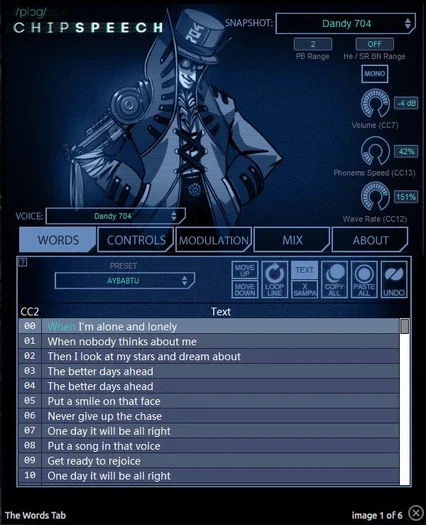
We end this list with another plugin from Plogue. chipspeech recreates the character of early speech-synthesis hardware. Type in your text and play the result with MIDI notes, then use its controls to turn that voice into a musical part.
The different voice models are its main attraction: they cover several synthesis methods rather than offering a row of similar modern singers. It is a good choice for retro computer voices, odd backing parts and sound design. Circuit-bending controls provide another route into rougher textures.
The current download is version 1.982. It runs standalone or as VST3 and CLAP on Windows, macOS and Linux, with AU on Mac and AAX on Windows/Mac. Plogue lists Windows 10 or later, macOS 10.13 or later and Linux kernel 5.4 or later, alongside processor requirements for each platform.
chipspeech is paid software, registered with a personal licence-key image. The unregistered download is a restricted demo with four-minute sessions and no saving; it is not a free full version. Its deliberately synthetic delivery makes more sense for character and texture than for a realistic singer.
How to use Text to Speech Plugins
Speech plugins do not need to be the main ingredient in your song. Use them to create small additions to your original mix and experiment with which phrases work against the beat. A few words before a chorus can be more useful than a long spoken passage.
You can also process and chop up the rendered audio. Try moving a syllable onto a different beat, repeating the end of a word, or sending a short phrase through delay. Working with audio lets you keep a useful performance even when you later change the plugin setup.
For singing instruments such as Alter/Ego, VOCALOID6 and Synthesizer V, the notes and lyric timing need attention as well as the text. Start with a short melody, listen for awkward consonants, and adjust the phrasing before building the rest of the arrangement around it.
Check the plugin format before installing. AU is for compatible Mac hosts, VST3 is not the same format as older VST releases, and a standalone application can run without a DAW. Voicebank requirements and commercial-use terms belong to the particular voice you choose.
Summary
For free experiments, Alter/Ego gives you playable singing synthesis and VST Speek provides crunchy robotic speech. chipspeech offers a broader set of vintage voice characters, while VOCALOID6 and Synthesizer V Studio 2 Pro are better suited to detailed melodic vocal arrangements. Choose the workflow and voice that fit your song, then check that the exact edition runs in your setup.