The 4 Best MIDI Guitar Controllers (2026)

Most of us are familiar with MIDI controllers, which are used to control virtual instruments and synths by assigning sounds from your DAW to the controller. MIDI guitar controllers do the same job but in the shape of a guitar.
They come in two different versions; the first one is a guitar-shaped MIDI controller, and the other one is a MIDI pickup which turns your actual guitar into a MIDI controller. So, you can play any assigned sound like piano, saxophone, drum, etc. from a guitar.
My top recommended choice is the Jamstik Standard MIDI Guitar (Black). This is a high-quality electric guitar with full MIDI capabilities, made for the studio.
My second recommended choice is the Jamstik Core MIDI Guitar (Black). This is a compact USB-powered MIDI guitar for a smaller recording setup.
Contents
- The 4 Best MIDI Guitar Controllers (2026)
- 1. Jamstik Standard MIDI Guitar (Black)
- 2. Jamstik Core MIDI Guitar (Black)
- 3. Fishman TriplePlay Express
- 4. Fishman TriplePlay Wireless
- Can a Guitar be a MIDI Controller?
- How do you Make a Guitar MIDI?
- How do I Make my MIDI Guitar Sound Real?
- How does a MIDI Work with Guitar Pedals?
- Summary
The 4 Best MIDI Guitar Controllers (2026)


Let’s compare them in more detail.
1. Jamstik Standard MIDI Guitar (Black)
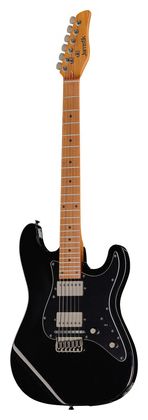
The Jamstik Standard MIDI Guitar is my top choice for a guitarist who wants a normal full-size electric guitar with MIDI built in. You can play its dual humbuckers through a guitar amp, send MIDI to a software instrument, or record both kinds of performance. That makes it a useful studio instrument without forcing you to switch to a keyboard for every synth part.
Pros
- Normal electric-guitar and MIDI outputs
- USB-C, TRS-MIDI and Bluetooth MIDI
- Per-string expression and MPE support
Cons
- Needs setup and a suitable software instrument
- Larger than compact controllers
- European retailer option
This is the black Standard model, with a traditional headstock rather than the older Studio model’s headless design. USB-C, 3.5 mm TRS-MIDI, and Bluetooth MIDI give you several connection options. The rechargeable battery supports wireless MIDI use, while the usual quarter-inch output handles the guitar’s analog audio. Bluetooth MIDI sends note information rather than guitar audio.
The per-string MIDI system supports expressive playing and MPE-compatible instruments. Bends and other guitar techniques can affect the software sound, but the result still depends on the patch and its MIDI settings. A convincing saxophone or piano part also needs phrasing suited to that instrument; changing the sound alone will not do all the work.
| Type | Full-size MIDI electric guitar |
| MIDI connections | USB-C, 3.5 mm TRS-MIDI, Bluetooth |
| Guitar pickups | Two humbuckers |
| Power | Rechargeable battery or USB |
Choose the Standard for a familiar full-size guitar and the widest connection choices. The Core below is more compact and uses USB power, while Fishman’s pickups let you keep the guitar you already own. Keep the guitar tuned, follow the manufacturer’s firmware and calibration instructions, and use wired audio monitoring for the best playing response. The black Standard shown here is available through Thomann; check delivery arrangements for your region.
2. Jamstik Core MIDI Guitar (Black)
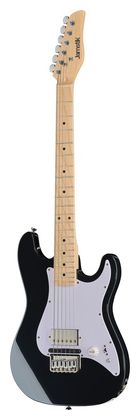
The Jamstik Core is the compact alternative if you want a complete MIDI guitar with a simpler wired setup. Its smaller body reduces bulk, but the 25.5-inch scale length keeps a normal guitar string length. It is more familiar to a guitarist than a touch-pad instrument, and the single humbucker also lets you use it as an ordinary electric guitar.
Pros
- Compact body with normal scale length
- USB-C and TRS-MIDI outputs
- Single-channel, multi-channel and MPE modes
Cons
- No Bluetooth or battery-powered MIDI operation
- Needs USB power for MIDI
- European retailer option
USB-C powers the MIDI system and sends notes to a compatible computer or device. A 3.5 mm TRS-MIDI output gives another route to MIDI equipment, with the appropriate adapter and power arrangement. The three-way MIDI selector provides single-channel, multi-channel, and MPE modes, so you can choose the approach your software instrument supports.
There is no Bluetooth MIDI or internal rechargeable battery on the Core. I would choose it for a computer-based studio where a wired connection is easy, rather than for walking around with a wireless setup. The Standard above is the better fit if you need the battery and Bluetooth connection as well as a larger body.
| Type | Compact MIDI electric guitar |
| MIDI connections | USB-C and 3.5 mm TRS-MIDI |
| Scale/frets | 25.5 inches; 22 frets |
| Power | USB-powered MIDI system |
This listing is the black Core with a white pickguard and one humbucker. It has a poplar body, roasted maple neck, and 22 frets. The compact body is the reason to choose it, but it still needs a sound source for MIDI playback and careful tuning for tracking. The black Core shown here is sold by Thomann; check international shipping and delivery arrangements if you are buying outside Europe.
3. Fishman TriplePlay Express
The Fishman TriplePlay Express is my wired pickup choice for turning a guitar you already own into a MIDI controller. It combines a hexaphonic pickup with a small controller and connects to a computer or compatible mobile device over USB-C. This is a direct USB-MIDI route, unlike a divided pickup that needs a separate compatible guitar-synth processor before it can control your software.
Pros
- Use your existing compatible steel-string guitar
- Direct USB-C MIDI connection
- No battery charging for the pickup
Cons
- Guitar fit and pickup setup need checking
- USB cable limits movement
- Nylon-string guitars are unsupported
The magnetic mounting system avoids permanent modifications on compatible guitars. Check pickup clearance and the installation guide before buying: it is intended for suitable six-string guitars with steel strings, and nylon-string classical guitars are not supported. The pickup has to sit correctly beneath the strings for dependable note tracking.
Basic operation sends all strings on one MIDI channel, while the TriplePlay Utility software lets you adjust the configuration. The controller’s buttons can send program changes and its knob can control MIDI volume. It is useful for playing software synths, entering notation, or recording MIDI in a DAW while keeping familiar guitar technique.
| Type | Hexaphonic guitar MIDI pickup/controller |
| Connection | USB-C MIDI |
| Power | USB |
| Hardware MIDI | Requires suitable host/interface; FC-1 is optional |
The USB cable powers the controller, so there is no wireless receiver or pickup battery to charge. The TriplePlay Wireless below is a better option if a cable would get in the way on stage. For hardware MIDI equipment, the optional FC-1 floor controller needs the appropriate firmware and setup. Choose the Express for a straightforward wired computer workflow, with a choice of Sweetwater and Thomann buying options.
4. Fishman TriplePlay Wireless
The Fishman TriplePlay Wireless is a small device that turns your guitar into a MIDI controller. Its hexaphonic pickup sends MIDI over a proprietary 2.4 GHz wireless connection to a USB receiver on your computer or compatible device. This is separate from Bluetooth MIDI. Correct installation and playing technique help with tracking. It allows you to assign different sounds to your guitar, allowing you to play any kind of instrument through it.
Pros
- Low latency accurate processing
- Playing a real guitar as a MIDI controller
- Versatile and practical
Cons
- A bit of a learning curve to get clear results
The Fishman TriplePlay Wireless is easily fitted to your guitar with no damage and is powered by a lithium rechargeable battery that lasts long enough for extensive playing. You can use the Fishman’s app to gain access to loopers, sequencers, virtual instruments, and effects, but many users report that it has a pretty complicated installation process.
Although the pickup is relatively successful at getting your playing nuances, you will have to adapt your playing style and technique to get the most out of it.
| Type | Hexaphonic MIDI Pickup |
| Connection | 2.4 GHz wireless to USB receiver; USB charging |
Overall, it is a great tool that stimulates creative practicing and playing, also giving you a range of different and cool sounds to play through your guitar in live performances.
Can a Guitar be a MIDI Controller?
Yes, there are MIDI guitar pickups and audio-to-MIDI converters that receive the signal from your guitar turning it into MIDI signals to be processed in a DAW of choice. If you want to use your guitar as a MIDI controller, you can choose one of these devices.
There are also guitar-shaped MIDI controllers, which are actually MIDI controllers meant to be played like a guitar on which you can even use guitar techniques such as legatos, bends, and slides. Although they are close to real-guitar playing experience, you will need some time to get used to playing these devices.
How do you Make a Guitar MIDI?
As mentioned before, with a MIDI guitar pickup like TriplePlay Fishman or an wired MIDI pickup like the TriplePlay Express, you can turn your own guitar into a MIDI controller. These devices allow you to convert your guitar signals to MIDI signals so that you can make your guitar sound like any other instrument configured in your DAW.
How do I Make my MIDI Guitar Sound Real?
Although MIDI Guitar Controllers are still evolving, there are some impressive-sounding devices like the Jamstik Standard and Core MIDI guitars. These are electronic devices like other MIDI controllers like MIDI keyboards designed to replicate the guitar playing experience with utmost reality. So, you can use any guitar technique like bends, slides, legatos, and strumming chords with these instruments to sound more realistic.
However, the realism of the sound comes to your VST Virtual Studio Technology Instrument in the end. You have to own suitable virtual instruments and plug-ins to make the electronic devices sound realistic. There are many great ones that you can use with some DAWs or as standalone software, with which you can create hyper-realistic guitar sounds.
How does a MIDI Work with Guitar Pedals?
There are many MIDI-enabled guitar pedals that you can use with MIDI instruments, and there are also MIDI foot controllers to use with your real guitar for switching between your MIDI plug-ins and effects.
You can use your MIDI guitar controller with MIDI-enabled guitar pedals. These pedals allow the users to change presets and control the parameters like knobs and switches via continuous controller (CC) and program change messages.
Connect a compatible MIDI output to the pedal’s MIDI input; USB-only devices need a suitable MIDI host or interface. This way, the MIDI controller sends commands to the pedal programming it as you like with endless setting options.
I know it sounds complicated, but it is not when you take a few steps in the MIDI world. You can check out this video to learn more about using MIDI with guitar pedals.
On the other hand, MIDI foot controllers work similarly but the other way around. You can think of them as a “blank page” pedal that you assign the effects and plug-ins you want from third-party software, a DAW, to use these effects with your real guitar.
Summary
MIDI guitar controllers are getting better and better with technology giving guitarists much more control and creative opportunities through the MIDI world. You can use a MIDI guitar controller or a MIDI pickup/converter to turn your guitar into a MIDI controller to benefit from the wide world of MIDI while playing guitar.
My top pick is the Jamstik Standard MIDI Guitar (Black), a high-quality electric guitar with full MIDI capabilities, made for the studio.
My compact pick is the Jamstik Core MIDI Guitar (Black), a compact USB-powered MIDI guitar for a smaller recording setup.